
Disclosure first: we run Base Note, a luxury fragrance subscription that ships a 5 ml atomizer of designer and niche scents every month for a flat $20. A post arguing that you should sample before you buy a full bottle is, transparently, a post arguing that you should do the thing we sell. So we are going to be careful. We will concede the strongest argument against us, show the arithmetic rather than assert a conclusion, and tell you exactly which number we removed from our own headline and why. If the honest version leaves you buying a full bottle, that is a fine outcome.
If you only read one thing: Sampling is not about saving money. On a per-wear basis, a full bottle you genuinely love and actually finish is one of the cheapest things in your bathroom. Sampling is about raising the probability that the bottle you buy is one you finish. The expensive mistake is not the $300 bottle — it is the $300 bottle worn five times. Wear a candidate on your own skin, for a full day, at least three separate times, before you commit. If it survives that, buy the bottle. We will happily lose you as a subscriber to a scent you love.
First, about the 74% we took out of the headline
This post was commissioned under the title “Should You Sample Before You Buy? 74% of Buyers Say Yes,” on the strength of a widely repeated claim: that 74% of people who buy fragrance as a gift regret the full-size purchase because it was never tested on the recipient.
We went to find the primary source so we could quote it accurately and give you the sample size and the year. We could not find it — not the survey, not the methodology, not a page on the publisher’s own site carrying the number. What we found was a figure circulating without a traceable origin, which is the usual shape of a statistic copied from one blog to the next until it acquires the appearance of evidence.
So we dropped it. A number appears on this blog only if we opened the source ourselves. That rule is worth more than a punchier headline, and the whole argument below is that you should not accept confident-sounding claims about a fragrance without testing them. It would be a strange piece that exempted itself.
What follows is built out of things you can check: mechanisms, arithmetic, and one statistic we did open.
The one number we can point at, and what it does and does not prove
The retail-wide picture is genuinely enormous. The National Retail Federation and Happy Returns found that “total returns for the retail industry are projected to reach $890 billion in 2024,” and that “76% of consumers consider free returns a key factor in deciding where to shop” (Source: NRF and Happy Returns, 2024).
Be careful with what that means. It is an all-categories figure and it says nothing specific about perfume. What it establishes is the background condition: buying things you have not experienced is a mistake consumers make at industrial scale, and retail is built to absorb it.
Fragrance is worse than average on exactly this axis, for a structural reason. A sweater that does not fit goes back. A 100 ml bottle you sprayed twice and disliked is, in most cases, yours forever. Fragrance is one of the few categories where you cannot evaluate the product without destroying your ability to return it — and where the evaluation takes eight hours rather than eight seconds.
Why blind buys fail, mechanically
There are three distinct failure modes, and they fail at different points on the clock. Which one you are exposed to determines how long a trial you need.
1. Your skin is not the paper strip, and not your friend’s arm
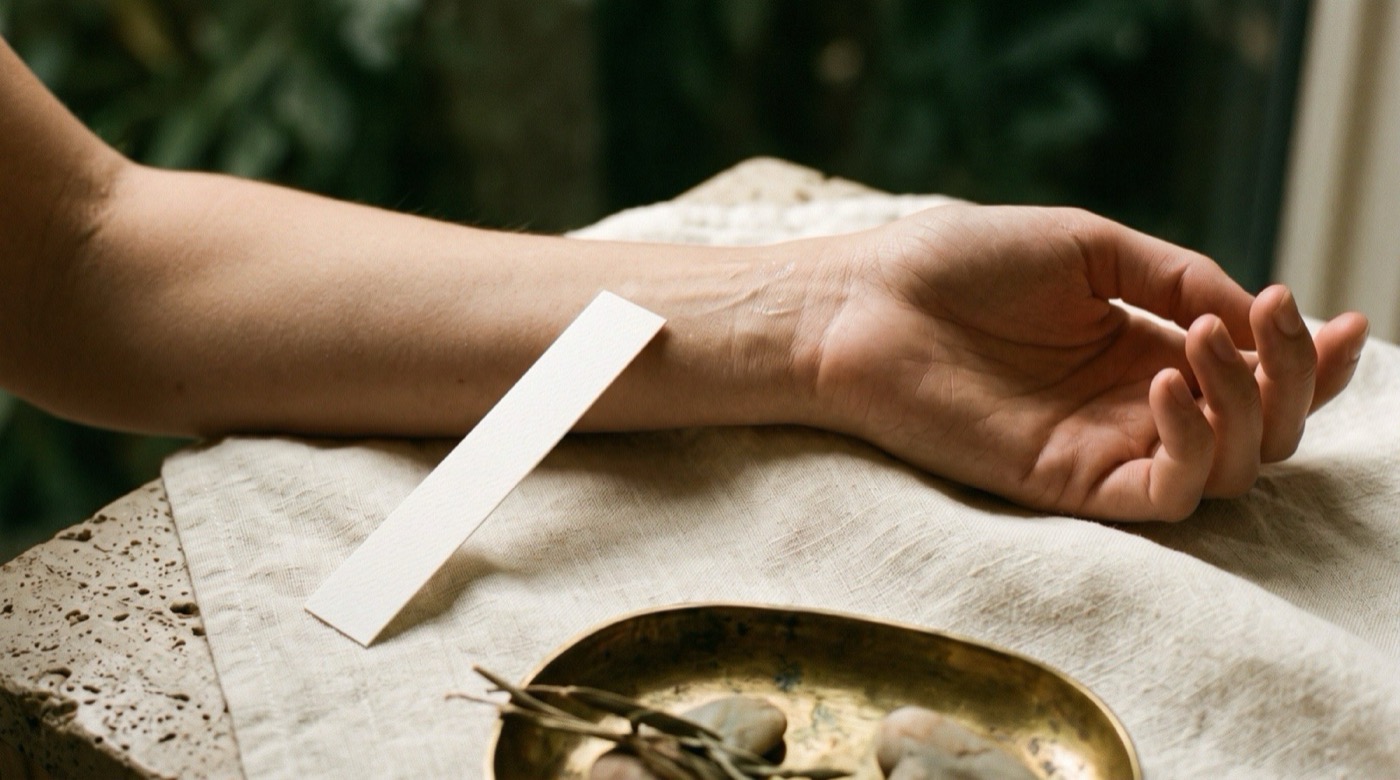
The same fragrance genuinely smells different on different people. Skin temperature changes the evaporation rate, sebum acts as a fixative, and pH influences how quickly some materials break down. That is why a scent that floored you on someone else can go flat, sour or unexpectedly loud on you. We take it apart in why perfume smells different on me than on my friend and in the pillar guide, why you smell the way you do.
The practical consequence: a recommendation is a hypothesis about someone else’s skin. Useful for building a shortlist, not evidence about yours.
2. You bought the top notes and you will live in the base notes
A note list is a timeline, not an ingredient panel. The opening you smell at the counter lasts roughly five to thirty minutes; what you wear all day is the dry-down. A 45-second spritz on a blotter strip is a decision made on the least representative part of the fragrance. Our guide to top, heart and base notes covers reading a pyramid bottom-up.
Creed Aventus is the clean example. It opens on blackcurrant, bergamot and lemon — bright, fruity, immediately likeable. It moves into a pineapple, pink pepper and jasmine heart, then settles into musk, birch and patchouli. Those are two different fragrances separated by about two hours, and the people who love the opening but dislike smoky dry-downs are exactly the people who buy this bottle and stop reaching for it.
3. You bought a fragrance for a life you do not have
The third failure is neither chemistry nor time. It is fit. Viktor & Rolf Spicebomb Extreme — lavender, black pepper, saffron and caraway over cinnamon, cumin and tobacco, landing on vanilla, amber and pipe tobacco — is a superb cold-weather evening fragrance. Wear it to a warm open-plan office in June and the problem is not the perfume. A scent can be excellent at projection, sillage and longevity and still be wrong for your week.
| Failure mode | When it shows up | What a counter test catches | Trial length that actually catches it |
|---|---|---|---|
| Skin chemistry mismatch | 30 minutes to 3 hours in | Nothing — a strip has no chemistry | One full day on your own skin |
| Dry-down mismatch | 2 to 8 hours in | Nothing — you left before it arrived | One full day, including the evening |
| Occasion or season mismatch | Weeks in | Nothing — the store is climate-controlled | Two to four weeks of real wear |
| You simply dislike the opening | Immediately | This one, and only this one | 30 seconds — counters are good at this |
Read that last row honestly. Department-store counters are not useless — they are excellent at ruling things out fast, and close to worthless at ruling things in.
The honest case for just buying the bottle
Here is the argument against us, stated at full strength.
If you already know your signature scent, sampling is a tax. A 100 ml bottle of something you wear two hundred times is one of the best value-per-use purchases available to an adult, and every month spent on a 5 ml vial of something new is a month not spent wearing the thing you actually want to smell like.
The subtler version, which we think is also correct: some fragrances only reveal themselves at the twentieth wear. A scent can be underwhelming on a Tuesday and extraordinary on the right October evening, and a one-month trial can genuinely under-rate it. Anyone who tells you sampling fully substitutes for living with a fragrance is overselling.
Our position is narrower than “always sample.” It is: sample when the cost of being wrong is high and the information is cheap to buy. That describes a first niche purchase, an unfamiliar note family, a gift, and any bottle over roughly $150. It does not describe a repurchase of something you have worn for two years.
Cost per wear, worked out
Most sampling articles skip this part, because the arithmetic is less flattering to subscriptions than you would expect. Here it is anyway.
Our own figure is that a 5 ml atomizer gives roughly 60 sprays — derivation in how long a 5 ml atomizer lasts. Scaling the same spray volume up, a 100 ml bottle is roughly 1,200 sprays: about 300 wears at four sprays each, against about 15 from a vial. The $300 bottle below is a round illustration, not a quoted price for any specific fragrance.
| Scenario | What you pay | Wears you actually get | Cost per wear |
|---|---|---|---|
| $300 bottle you love and finish | $300 | ~300 | ~$1.00 |
| $300 bottle worn 20 times, then shelved | $300 | 20 | $15.00 |
| $300 bottle worn 5 times, then shelved | $300 | 5 | $60.00 |
| Base Note, one month | $20 | ~15 | ~$1.33 |
| Base Note, first month at 25% off | $15 | ~15 | ~$1.00 |
Notice what the table actually says. A subscription is not cheaper per wear than a bottle you love; it is roughly the same. What it changes is variance. The bottle path has an outstanding best case and a brutal worst case, and you commit $300 before you know which one you are in. The vial path costs about the same in the good case and caps your downside at $20 in the bad one.
That is the entire honest argument for sampling, in one line: you are not buying a discount, you are buying information at a price you can afford to lose.
What a real trial actually looks like
Most people sample badly, then conclude sampling does not work. A trial that produces a decision looks like this.
- Skin, not paper. Two to four sprays, on the wrist and the side of the neck. Do not rub.
- One fragrance at a time. Your nose adapts within minutes. Testing four scents in one visit means you evaluated the first one and guessed at the rest.
- Check at 30 minutes, 3 hours, and bedtime. Heart, early dry-down, base. The bedtime check is the one that predicts whether you still like this in six months.
- Wear it three separate days, including at least one you did not plan around the fragrance.
- Ask one other person, once. You go nose-blind to your own scent long before anyone else does.
- Write one sentence after each wear. Memory for smell is vivid and unreliable. “Too sweet by hour four” beats a week of recollection.
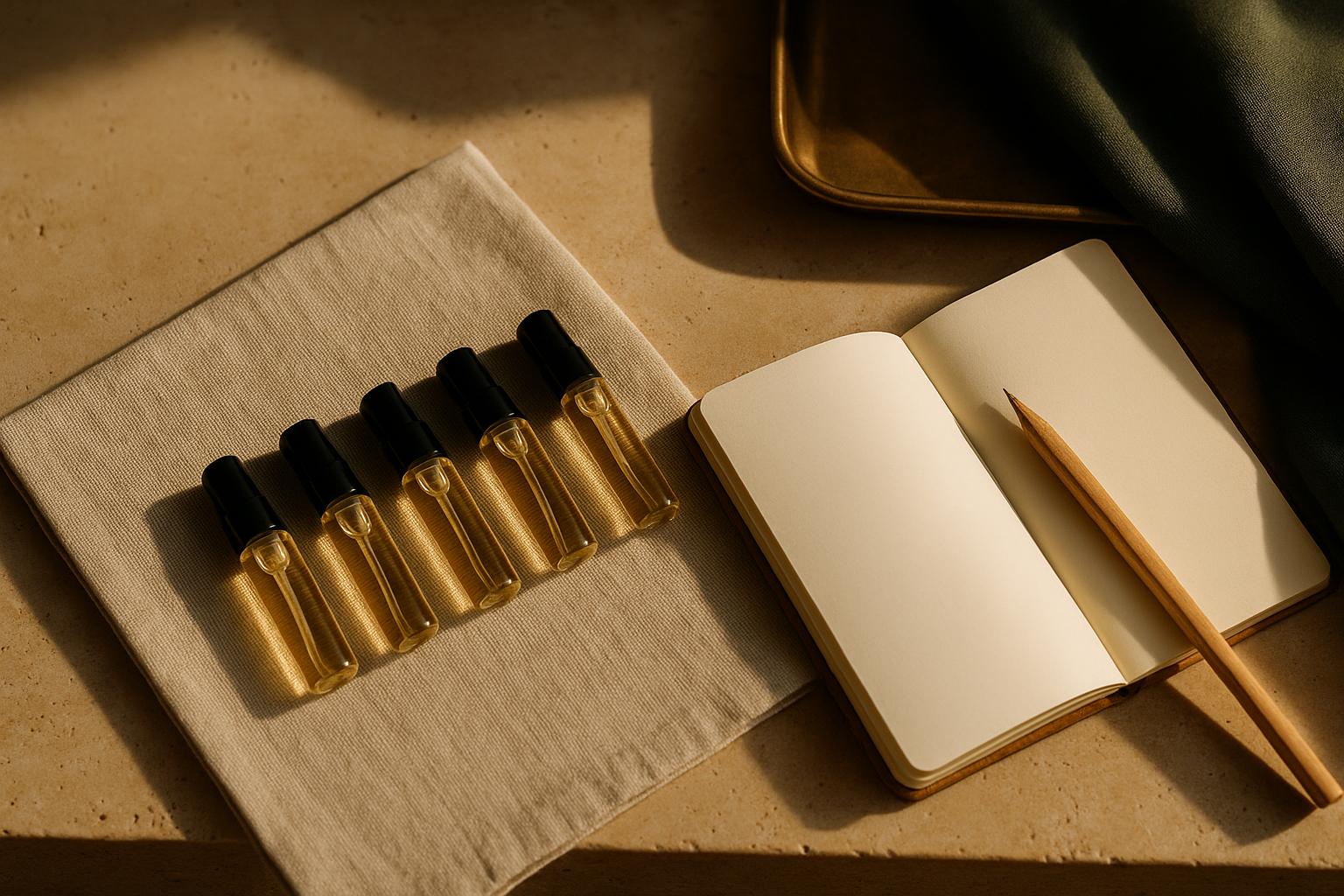
A 5 ml atomizer covers all of that with sprays left over. That is the design logic of the format.
Three places to start, and what they are testing
All three are in the rotation at the same flat $20 — no designer surcharge, no premium tier. Each tests a different question about your taste.
- Creed Aventus — blackcurrant, bergamot and lemon over a pineapple, pink pepper and jasmine heart, into musk, birch and patchouli. Tests whether you like a smoky dry-down under a bright fruity opening — the gap that catches out more blind buyers than any other. Our honest Aventus review goes deeper.
- Parfums de Marly Layton — apple, bergamot and cardamom over lavender, violet and geranium, landing on vanilla, patchouli and guaiac wood. Tests your tolerance for sweetness: it is the fastest way to find out whether vanilla-forward compositions read as luxurious or cloying on your skin.
- Creed Green Irish Tweed — verbena over lavender, violet and geranium, into sandalwood and Ambroxan. Tests the opposite pole: dry, green, woody, no sweetness at all. If Layton works and this does not, you have learned more about your taste in two months than in two years of reading reviews.
One honest note on scope, since people ask: Maison Francis Kurkdjian and Le Labo are not in our rotation, and we would rather say so plainly than let a search-friendly name imply otherwise. If you are chasing the saffron-and-amberwood profile of Baccarat Rouge 540, the closest things we carry by note structure are Initio Side Effect (rum and cinnamon over tobacco and saffron) and Valentino Born in Roma Intense (bourbon vanilla, lavender, smoked vetiver). Relatives, not replacements — anyone selling a one-for-one match is selling something.
When to stop sampling and commit
Sampling is a phase, not a lifestyle. Buy the bottle when all four of these are true:
- You have worn it at least three full days, on your own skin, across different conditions.
- You liked it best at the eight-hour mark, not the first ten minutes.
- You have reached for it unprompted — not because it was the month’s vial, but because you wanted it.
- You can name the occasion. “Everything” is not an occasion, and it is usually the answer people give right before a bottle starts collecting dust.
For structure around that, our five-slot rotation guide covers how many fragrances a normal life needs, and our honest comparison of fragrance subscriptions covers how the services differ — including where we come out worse than the alternatives.
The bottom line
Should you sample before you buy a full bottle? If you already know what you want to smell like, no — buy the bottle, wear it two hundred times, and enjoy the best cost-per-wear in your bathroom. If you do not, sampling is not a way to spend less. It is a way to make the eventual $300 decision from evidence instead of from a 45-second impression in a store with the wrong lighting, the wrong temperature and none of your chemistry.
We could not verify the 74% that was meant to headline this post, so you did not get it. You got the mechanism, the arithmetic, and a protocol you can run without us. If you would rather run it with us: $20 a month, flat, for a 5 ml atomizer of any of the 32 fragrances in the rotation — Creed, Tom Ford, Parfums de Marly, Xerjoff, Bond No. 9 and the rest, all at the same price. First month 25% off, swap monthly, cancel anytime.
Not sure where to start? Take the scent quiz, or browse the full rotation and pick whichever you are most curious about. Curiosity is a better starting filter than a review.
— Jeff Theefs & Alex Cherne
Founder & Cofounder, Base Note