
Disclosure first: we run Base Note, a luxury fragrance subscription that ships a 5 ml atomizer of designer and niche scents every month for a flat $20. So we are the last people you should take a “yes, obviously” from on this question. What follows is the arithmetic with our own product dropped into the same table as the full bottles, using prices we pulled off the brands’ own websites on 18 August 2026. In three of the six comparisons below, the full bottle is cheaper per milliliter than we are. We left those rows in.
If you only read one thing: A fragrance subscription is not cheaper per milliliter than a full bottle — sometimes it is, sometimes it isn’t, and the gap is smaller than either side of the argument pretends. What a subscription actually changes is your downside. If you fall in love with a $510 bottle and finish it, that bottle costs you about $1.70 a wear and beats almost anything. If you wear it twenty times and shelve it, it cost you $25.50 a wear. A 5 ml atomizer caps that same mistake at $20. Buy the subscription for the twenty-times outcome, not the finish-the-bottle one. And if you already have a signature scent you wear daily, or you wear one spray a day, skip us — the math genuinely does not work in our favor.
The two numbers that decide this
Almost every argument about fragrance subscriptions is really two different arguments wearing one coat.
The first is cost per milliliter. This is the one people shout about on Reddit, and it is the less useful of the two. It tells you what the liquid costs. It does not tell you what wearing the fragrance costs you, because it silently assumes you use every last drop.
The second is cost per wear — the bottle price divided by the number of times you actually put it on your skin before you stop reaching for it. That second clause is where all the money hides. Cost per milliliter is a property of the bottle. Cost per wear is a property of your behavior.
Run both. They give different answers, and the difference is the whole decision.
How many sprays are actually in a bottle
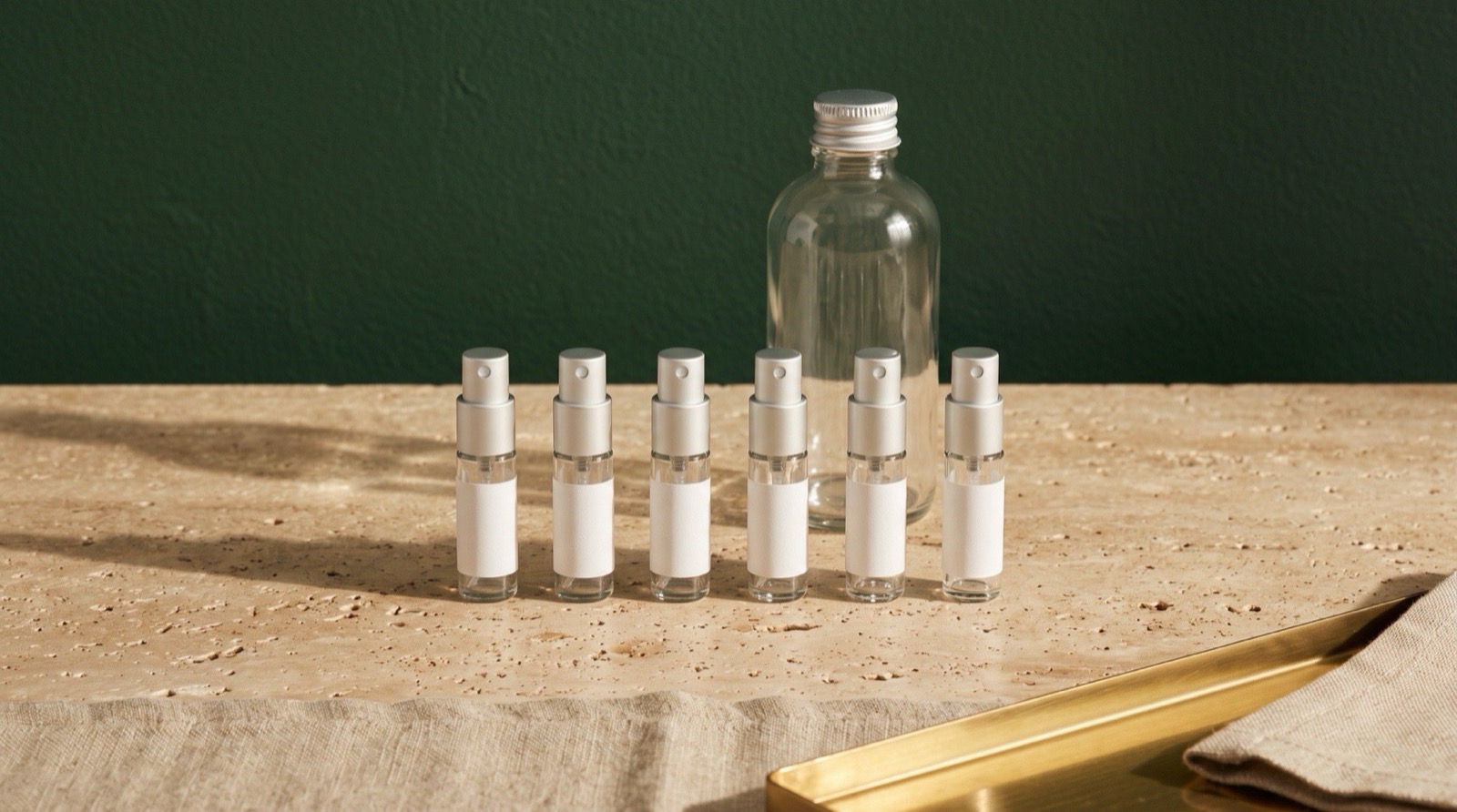
To turn a price into a cost per wear, you need a spray count. Ours is the number we build the product around: a Base Note 5 ml atomizer delivers roughly 60 sprays. That works out to about 0.083 ml per press — a normal atomizer dose. We walk through where that figure comes from, and the reasons your own count will drift from it, in how long a 5 ml atomizer lasts.
Apply the same dose to full bottles and the arithmetic falls out:
- A 75 ml bottle holds roughly 900 sprays
- A 100 ml bottle holds roughly 1,200 sprays
- A 125 ml bottle holds roughly 1,500 sprays
One caveat we should name rather than bury: pump volumes vary between houses, and a heavy trigger finger will use more than 0.083 ml. Treat every number below as accurate to within maybe fifteen percent, which is plenty accurate enough to make a decision with and not accurate enough to argue about.
Then you need a definition of a wear. We use four sprays throughout — a fairly standard everyday application for an eau de parfum. If you wear two, halve every per-wear figure. If you wear six, add fifty percent. The right number changes with the fragrance and with the room you are walking into, so pick the one that matches how you actually spray.
The table: full bottles versus a 5 ml atomizer
Every full-bottle price below was read off the brand’s own site on 18 August 2026. All six fragrances are in the Base Note rotation, so this is a like-for-like comparison of the same juice bought two different ways.
| Fragrance and size | Price | Per ml | Per spray | Per wear (4 sprays) | Wears in it |
|---|---|---|---|---|---|
| Creed Aventus, 100 ml (Source: Creed Boutique, 2026) | $510 | $5.10 | $0.43 | $1.70 | ~300 |
| Creed Silver Mountain Water, 100 ml (Source: Creed Boutique, 2026) | $490 | $4.90 | $0.41 | $1.63 | ~300 |
| Bond No. 9 Bleecker Street, 100 ml (Source: Bond No. 9, 2026) | $470 | $4.70 | $0.39 | $1.57 | ~300 |
| Parfums de Marly Layton, 75 ml (Source: Parfums de Marly, 2026) | $290 | $3.87 | $0.32 | $1.29 | ~225 |
| Parfums de Marly Layton, 125 ml (Source: Parfums de Marly, 2026) | $400 | $3.20 | $0.27 | $1.07 | ~375 |
| Parfums de Marly Pegasus, 75 ml (Source: Parfums de Marly, 2026) | $290 | $3.87 | $0.32 | $1.29 | ~225 |
| Base Note 5 ml, monthly | $20 | $4.00 | $0.33 | $1.33 | ~15 |
| Base Note 5 ml, first month (25% off) | $15 | $3.00 | $0.25 | $1.00 | ~15 |
Read that honestly and here is what it says.
Against the very expensive houses, the atomizer wins on price per milliliter. A 100 ml Creed Aventus works out to $5.10 per milliliter. We charge $4.00. That is not a marketing trick; it is what happens when a house prices a 100 ml bottle above $500. Same story for Silver Mountain Water and for Bond No. 9.
Against Parfums de Marly, the bottle wins. A 125 ml Layton is $3.20 per milliliter against our $4.00, and $1.07 a wear against our $1.33. If Layton is already your scent and you know you will finish 125 ml, buying the bottle is the correct financial decision and we would rather tell you that than pretend otherwise. Layton is apple, lavender and bergamot over jasmine and violet, landing on vanilla, cardamom and sandalwood — a specific enough profile that plenty of people know within a week whether it is theirs.
Across the full-price rows, the whole spread is about $0.63 a wear. Between the cheapest way to wear one of these and the most expensive, you are arguing over the price of half a coffee a day. Cost per milliliter is simply not where the money is.
Where the money actually is: the wears you never take
Every per-wear number in that table assumes you finish the bottle. At one wear a day, a 100 ml bottle takes about ten months. A 125 ml bottle takes over a year. Almost nobody wears one fragrance every single day for a year.
So here is the same $510 bottle of Aventus, priced against what actually tends to happen:
| What you actually do with it | Wears | Real cost per wear |
|---|---|---|
| Wear it daily for ten months and finish it | 300 | $1.70 |
| Wear it a few times a week for a year | 150 | $3.40 |
| Save it for occasions, then move on | 60 | $8.50 |
| Wear it for a season, then lose interest | 20 | $25.50 |
| Realize on wear six that it is not you | 6 | $85.00 |
Now the same exercise on a $20 atomizer:
| What you actually do with it | Wears | Real cost per wear |
|---|---|---|
| Use the whole thing | 15 | $1.33 |
| Wear it half a dozen times, then swap | 6 | $3.33 |
| Two wears and you know it is wrong | 2 | $10.00 |
| Worst case, ever | — | capped at $20 |
That last row is the entire product. A subscription is not a cheaper way to buy fragrance. It is a cheaper way to be wrong about fragrance. The bad outcome on a full bottle is $85 a wear and a shelf ornament; the bad outcome on an atomizer is a wasted $20 and a month you would rather have back.
This matters more than usual with fragrance specifically, because you cannot evaluate one at a counter. What you smell on a blotter is the top notes and nothing else, and how a base behaves depends on your own skin — our pillar piece on why you smell the way you do covers the mechanism. A fragrance you loved in a store and cannot stand by hour three is not a rare failure. It is the default failure.
When a subscription is genuinely not worth it
Four situations where we would tell you to keep your $20.
You already have a signature and you wear it daily
If you own a bottle you reach for every morning, you are already on track to hit the good end of the first table. Adding $20 a month does not lower that cost per wear — it adds $240 a year on top of it for scents that compete with the one you have already chosen. If your signature is settled, the honest recommendation is a couple of one-off samples a year to check whether anything has displaced it, not a standing subscription. Our guide to building a fragrance wardrobe is written for the people who have not got there yet.
You wear one spray a day
This one is pure arithmetic and it is not close. At one spray a day, 60 sprays is sixty days of fragrance. A monthly subscription ships you two months of supply every thirty days. Within a year you are sitting on a drawer of half-used atomizers and you have paid full price for all of them. Light sprayers should either skip most months or not subscribe at all. We would rather say that than sell you a backlog.
Your favorite lives at a lower price tier
Everything in the table above sits at $290 and up. Plenty of excellent fragrance does not. If the scent you actually want to wear is a mid-priced designer bottle, go and look up its price on the brand’s own site, divide by its milliliters, divide again by 0.083, and multiply by four. If that number comes in comfortably under a dollar, the bottle wins and no subscription math will rescue us. We took that question apart on the most expensive bottle we carry in our honest review of Creed Aventus, and the answer there is not a straight yes either.
A monthly decision is a cost too
Choosing next month’s scent is fun for about four months. After that, for some people, it becomes another recurring small decision in a life already full of them, and the atomizers start piling up unopened. That is a real cost even though it never shows up in dollars. If you know that about yourself, believe yourself.
When it does pay
Three situations where the math genuinely favors a subscription.
You are shopping for something expensive and you have not committed. This is the strongest case by a distance. Three months of trialing before a $510 purchase costs $60 and removes most of the risk from the decision. If it stops you buying one wrong $470 bottle, it has paid for itself more than seven times over. Bleecker Street is a good example of why trialing matters here: violet leaf, blueberry and cassis on top, then oakmoss, suede and caramel underneath. That is a fragrance you will either find fascinating or find far too sweet, and you will not know which from a blotter strip.
You want a rotation, not a signature. If you want a fresh thing for summer, something heavier for evenings and a third for the office, you need three or four bottles at once. Four bottles at $400 is $1,600 sitting in a drawer. Rotating 5 ml atomizers gets you the same variety with no shelf capital, and everything you finish is something you already knew you liked. Silver Mountain Water — bergamot and mandarin over green tea and black currant, drying to musk and sandalwood — is a fine summer slot without a $490 commitment.
You want to know what you like before you know what you like. Most people who think they have narrow taste have narrow exposure. Twelve scents a year for $240 is a real education, and there is no way to get it from a store. Our ranked run through the 32 fragrances is a decent map of the territory, and the two-minute scent quiz is the fastest way to get a starting point.
Run your own numbers
Do not take ours. The formula is short enough to do in your head:
Cost per wear = bottle price ÷ (milliliters ÷ 0.083) × sprays per wear
Then — and this is the step everyone skips — do it a second time with the realistic wear count instead of the full-bottle one. Ask yourself honestly how many times you will wear this before something new catches your attention. Divide the price by that. That is the number that is actually true.
If both versions come out low, buy the bottle. If the first is low and the second is frightening, sample first. That is the whole decision tree.
What we charge, so you can put us in your own spreadsheet
$20 a month, flat, for a 5 ml atomizer of any of the 32 fragrances in the rotation — Creed, Parfums de Marly, Tom Ford, Xerjoff, Bond No. 9 and others. No surcharge for the expensive houses, which is the part of the model we care most about; Creed Aventus and Parfums de Marly Pegasus cost you the same $20 in a month you choose either one. First month is 25% off at $15. Swap monthly, cancel whenever. Every product page lists the concentration — eau de parfum unless marked otherwise — and the country of origin, because those two facts change what you are getting and both are usually buried.
If you want to see how that structure compares with the rest of the category, we did the feature-by-feature version in our honest comparison of 2026 fragrance subscriptions, and the switching-specific version in what Scentbird subscribers switch to.
The bottom line
Is a fragrance subscription worth it? If you have already found your scent and you wear it every day: no, and anyone telling you otherwise is selling. If you wear one spray a day: no, you will drown in unopened atomizers. If your taste sits at a lower price tier: probably not, and the arithmetic above will show you that in thirty seconds.
But if you are standing in front of a $510 bottle with no idea whether you will still like it in March — that is not a $510 question. It is a $20 question you have been handed as a $510 one. Answer the $20 version first.
— Jeff Theefs & Alex Cherne, Founder & Cofounder, Base Note
```