
Disclosure first: we run Base Note, a luxury fragrance subscription that ships a 5 ml atomizer — roughly 60 sprays — of designer and niche scents every month for a flat $20. We carry Creed, Tom Ford, Parfums de Marly, Xerjoff and Bond No. 9, so we plainly benefit if you decide fragrance is worth thinking about carefully. Which is why we want to be direct about the shape of this article: body odour is a biology problem before it is a fragrance problem. Almost everything below is glands, bacteria and one gene. Fragrance turns up at the end, and we will be specific about what it cannot do.
If you only read one thing: Fresh sweat is essentially odourless. What you smell is bacterial metabolism — named species on your skin eating odourless molecules in your sweat and excreting pungent ones. Two glands do different jobs: eccrine glands make the watery sweat that cools you, apocrine glands make the thick secretion bacteria turn into classic underarm odour. One gene, ABCC11, sets how much precursor your apocrine glands hand over — and the same letter of DNA also decides whether your earwax is wet or dry. None of this is a hygiene score.
The whole thing in one table
| Source | What it secretes | Who acts on it | What comes out | Smells like |
|---|---|---|---|---|
| Eccrine (everywhere, densest on palms and soles) | Mostly water and electrolytes; lactate, urea, ammonia | Skin staphylococci and cutibacteria | Short- and medium-chain volatile fatty acids | Sharp, sour, “post-workout” |
| Apocrine (armpits, perineum, ear canal, areola) | Glutamine-conjugated precursors — odourless | Corynebacterium | 3M2H and HMHA | Sour, cumin-like, the classic armpit note |
| Apocrine | Cys-Gly-3M3SH — odourless | Staphylococcus hominis | 3M3SH, a thioalcohol | Pungent, onion-sulphurous |
Sweat is odourless. Really.
This is the fact that reframes everything else. Apocrine sweat — the thick stuff your armpits produce — leaves your body with no smell at all. “Apocrine sweat is odorless and it only becomes odorous after breakdown by microorganisms inhabiting skin surface” (Source: International Journal of Molecular Sciences, 2020). The American Society for Microbiology puts it plainer still: the fluid is “naturally almost entirely odorless” (Source: ASM, 2021).
So when you catch a whiff of yourself at 4pm, you are not smelling sweat. You are smelling a chemical reaction that happened on your skin in the hours after you sweated, performed by organisms that live there permanently. Your sweat is the raw material. Your skin bacteria are the factory. It is also why antiperspirants and deodorants are genuinely different products: one reduces the raw material, the other targets the factory.
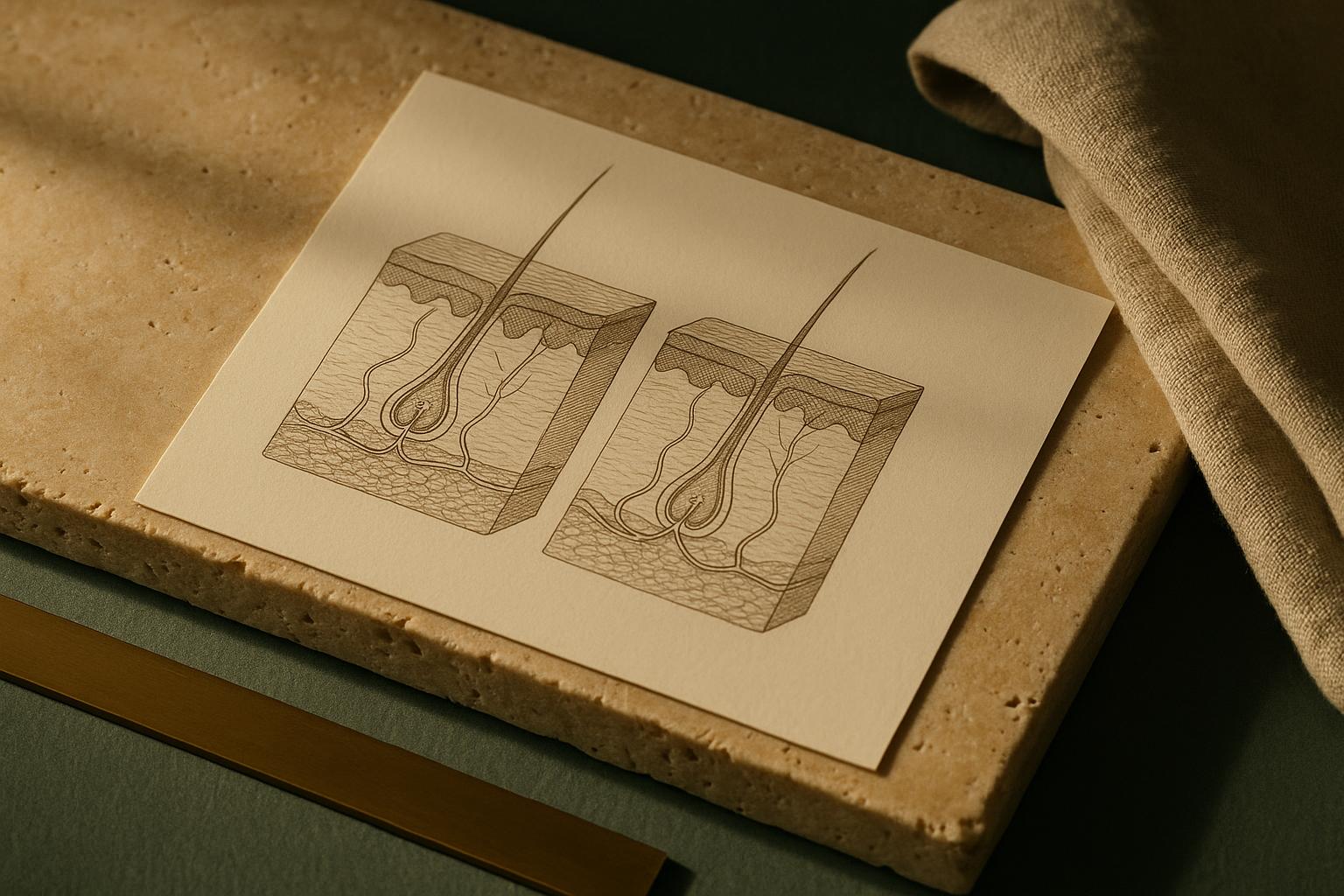
Eccrine vs. apocrine: two glands, two jobs
You have both, in very different places, and confusing them is the source of a lot of bad folk advice.
Eccrine glands sit almost everywhere, “with the highest concentration found on the palms and soles,” and their job is thermoregulation (Source: StatPearls, NCBI Bookshelf). This is the sweat that soaks a shirt.
Apocrine glands are “found in more restricted areas of the body, including the axilla, anogenital region, external ear canal, and areola” — and critically, they are absent from the palms and soles. Their secretion is “milky and odorless,” and “bacteria on the skin surface eventually break down the fluid, releasing a distinctive odor” (Source: StatPearls, NCBI Bookshelf).
Put those side by side and you get something counterintuitive: the sweatiest parts of your body are not the smelly parts. Sweaty palms are eccrine, with no apocrine glands anywhere near them. Sweating a lot and smelling a lot are separate variables, which is why “I barely sweat and I still smell” and “I sweat buckets and I don't” are both ordinary.
One more piece of anatomy resolves an old question: apocrine glands “are present when you're born but don't start working until you hit puberty, likely due to hormonal changes at that time” (Source: Cleveland Clinic). Small children genuinely do not have adult body odour. It was never about how well they washed.
The bacteria doing the work
Body odour is not produced by “bacteria” as a vague mass. It is produced by named species running named enzymes, and their near-identical neighbours cannot do it at all.
A 2020 paper in Scientific Reports traced the pungent underarm thioalcohols to one enzyme, a cysteine-thiol lyase, in Staphylococcus hominis. The authors found that “transfer of this enzyme alone to non-odour producing staphylococci confers odour production, demonstrating that this C-T lyase is both necessary and sufficient for thioalcohol formation” (Source: Scientific Reports, 2020).
Necessary and sufficient is unusually strong language in biology. The contrast next door is sharper still: Staphylococcus epidermidis, “the dominant staphylococcal species present on the skin including the axilla, does not metabolise Cys-Gly-3M3SH” (Source: Scientific Reports, 2020). Two staph species centimetres apart on the same armpit. One makes the smell. One is chemically incapable of it. The sour, cumin-like note most people picture as “armpit” comes from a different genus again — those odorants “are produced by some members of Corynebacterium, including Corynebacterium striatum, Corynebacterium jeikeium and Corynebacterium bovis” (Source: ASM, 2021).
Intensity has nothing to do with quantity
Thioalcohols, the paper notes, are “despite being present in trace amounts… the most pungent volatiles,” with 3M3SH “being the most abundant” of them (Source: Scientific Reports, 2020). The loudest thing coming off your skin is present in quantities you could not detect without a mass spectrometer — a decent argument against solving odour by adding volume of anything, fragrance included.
Your body odour is older than your species
The same paper dates the machinery's arrival by horizontal gene transfer into staphylococcal lineages, placing “the appearance and diversification of malodour producing staphylococci from the most recent common ancestor (MRCA) approximately 60 million years ago” (Source: Scientific Reports, 2020). We did not evolve body odour. We inherited a bacterial partnership that already had it.
The ABCC11 gene: one letter, two consequences
One framing rule first: what follows describes how often a gene variant appears in DNA databases. It says nothing about any individual, and it is not a claim about how any group of people smells.
A single-nucleotide variant in the ABCC11 gene — rs17822931 — controls the transporter protein that moves odour precursors into apocrine secretions. It also sets earwax type, which is how the link was found. A 2009 case-control study of clinically diagnosed axillary osmidrosis reported that “a total of 78 (98.7%) of 79 AO patients had either the GG or GA genotype, while these genotypes were observed in 35.4% (57/161) of the subjects from the general population,” at p < 1.1 × 10⁻²⁴ (Source: BMC Genetics, 2009). Wet earwax and typical underarm odour travel together; dry earwax and low odour travel together.
It is also one of the most unevenly distributed variants in the human genome. Across the whole ALFA reference dataset, the low-odour allele sits at roughly 13% overall — 48,006 of 363,574 alleles sampled — while the individual population samples inside that dataset run from under 1% to above 80% (Source: NCBI dbSNP, ALFA data). That is a wide spread, and it is a fact about a database, not about anyone you have met.
Two caveats stop this being misread. First, you need two copies of the low-odour variant to land in the low-odour group — a single copy of the other allele puts you in the typical-odour category, so the share of people with the low-odour genotype is much smaller than the allele frequency wherever that allele is uncommon. Second, genotype does not predict behaviour. In a UK cohort of roughly 17,000 people, 77.8% of “genotypically nonodorous individuals still used deodorant,” while only “4.7% genotypically odorous individuals did not” (Source: Journal of Investigative Dermatology, 2013).
More than three quarters of the people who biologically produce very little underarm odour buy and apply deodorant anyway. Most deodorant use is social habit, not biological need.
Why hygiene alone won't fix it
If odour is bacterial metabolism, washing is not deleting a smell — it is temporarily resetting a population that lives on you and will return, because it is supposed to. Which species dominate is not a cleanliness score. Two people can shower identically and end the day differently.
The variable most often overlooked is what goes on top. In a 2014 study, 26 healthy volunteers wore cotton and synthetic T-shirts through a one-hour intensive bicycle spinning session, and the shirts were then assessed by a trained odour panel. The verdict was blunt: “The polyester T-shirts smelled significantly less pleasant and more intense, compared to the cotton T-shirts.” The microbiology tracked the smell — “Micrococci were isolated in almost all synthetic shirts and were detected almost solely on synthetic shirts” (Source: Applied and Environmental Microbiology, 2014). Same people, same session, same sweat.
Worth saying what the same study did not find, because it keeps the claim honest. Corynebacteria — the genus behind the sour, cumin-like note — were not enriched on any fabric, and “Staphylococcus hominis bands were solely present on the 100% cotton clothing” (Source: Applied and Environmental Microbiology, 2014). Fabric changes which organisms take up residence in the shirt, and how the shirt reads to a nose. It does not switch your body odour on or off. If you wear synthetics for long stretches, your shirt is not a bystander — but it is not the whole story either.
One honest boundary. Persistent odour in skin folds, a sudden sustained change in how you smell, or a distinctly fishy odour in sweat, breath or urine are medical questions — the last is associated with trimethylaminuria, an inherited metabolic condition. Talk to a doctor. No perfume is an answer to any of them.
What fragrance can and cannot do
Cannot: stop the reaction. Fragrance sits on top of a live chemical process that continues underneath it. Anyone selling a scent as a solution to body odour is selling a cover, and covers get overwhelmed.
Can: combine with it into something specifically yours. This is the one part of the fragrance-and-skin story with a peer-reviewed anchor. In a 2012 PLOS ONE study, “the interaction between individual donors and perfume treatment was highly significant for all rated variables” — the same perfume produced measurably different results on different people. In the same work, men wore their own chosen perfume on one side and a randomly assigned perfume of comparable pleasantness on the other. Raters found “odor blends with the participants' own perfume were rated significantly more attractive (Z = 2.37; N = 21; p = 0.02) and pleasant (Z = 2.48; N = 21; p = 0.01) than blends with the assigned perfume” (Source: PLOS ONE, 2012).
The perfumes were equally pleasant on their own. The difference was fit. People had chosen, without being able to explain why, fragrances that worked with their particular blend — a scientific way of saying the right fragrance is a property of you and the bottle together, not the bottle.
What follows is the craft layer, flagged as such: matching notes to a baseline is perfumer convention, not published science. Treat it as a starting hypothesis you test on your own skin, in the spirit of our piece on why perfume smells different on you than on your friend.
| Your baseline | Strategy | Notes to reach for | From the rotation |
|---|---|---|---|
| Sharp and sour after exertion (eccrine-driven volatile fatty acids) | Contrast | Soft musk, vanilla, powdery amber | Xerjoff Erba Pura (white musk, Madagascar vanilla, amber) or Parfums de Marly Althair (praline, vanilla, orange blossom, cardamom) |
| Pungent and sulphurous (thioalcohol-forward) | Contrast — bright top over a dark base | Citrus and green over moss; the chypre structure | Dolce & Gabbana Light Blue (grapefruit, bergamot, Sicilian mandarin over musk, incense, oakmoss) |
| Faint, close to the skin | Congruent — nothing to counterbalance | Iris, sandalwood, soft woods, airy musk | Creed Green Irish Tweed (geranium, sandalwood, Ambroxan) or Prada Paradigme (airy musks, benzoin, guaiac wood) |
| Active, salty, warm-weather heavy | Contrast — and use less | Citrus, herbs, marine, tea | Acqua di Gio Profondo (sea notes, green mandarin, bergamot) or Xerjoff Torino 21 (mint, lemon, basil, thyme) |
| Warm and sweet-reading skin | Contrast with astringency | Grapefruit, bergamot, vetiver, green apple | Parfums de Marly Perseus (grapefruit, bergamot over vetiver and amberwood) |
The bottom line
You are not fighting your sweat. You are living with a bacterial population that has been converting odourless molecules into pungent ones for around sixty million years, running on raw material metered out by a gene you did not choose. That is not a flaw to correct. It is a baseline to work with.
The practical consequences are specific. Sweating less is not the same as smelling less. Cotton over polyester on long days does more than most people expect. Deodorant is a habit at least as much as a need. And the fragrance that suits you is not the one that scored best in a magazine — it is the one that lands well on your chemistry, which is only discoverable by wearing it.
For the full mechanism behind that last point, our pillar piece on why you smell the way you do goes deeper into skin, diet and note-matching. To just start testing, our scent quiz narrows the 32 fragrances in the rotation to a sensible first three.
Base Note is $20 a month, flat, for a 5 ml atomizer — about 60 sprays, which is a month of real wear rather than a single spritz at a counter. Same price whether you pick a designer house or a niche one; no surcharge on the expensive ones. First month is 25% off, so $15 to start and $20 a month after that; swap monthly, cancel anytime. The point is not to sell you a bottle. It is to give you enough wearings, on your own skin, to find out what your chemistry does with a fragrance — which, as the research above says fairly plainly, is the only place that answer exists.
— Jeff Theefs & Alex Cherne
Founder & Cofounder, Base Note