
Direct answer: Of the five picks in this guide, Creed Green Irish Tweed shares the most official notes with Dior Sauvage Eau de Parfum: bergamot, lavender and ambroxan. YSL Y Eau de Parfum Intense shares lavender, Parfums de Marly Perseus and Prada Paradigme share bergamot, and Versace Eros Eau de Parfum shares vanilla. These Dior Sauvage alternatives each have their own note list; none is a copy.
Disclosure: Base Note is a fragrance retailer that sells 5 ml atomizers of every fragrance in this guide, including Dior Sauvage Eau de Parfum, and benefits if you shop through the product links. The selection reflects products that were available on Base Note on September 14, 2026. Note descriptions come from the linked manufacturer pages; the choice of alternatives and the wearing suggestions are our editorial interpretation. We have not used unverified price, shipping, spray-count, or performance claims.
Explained simply
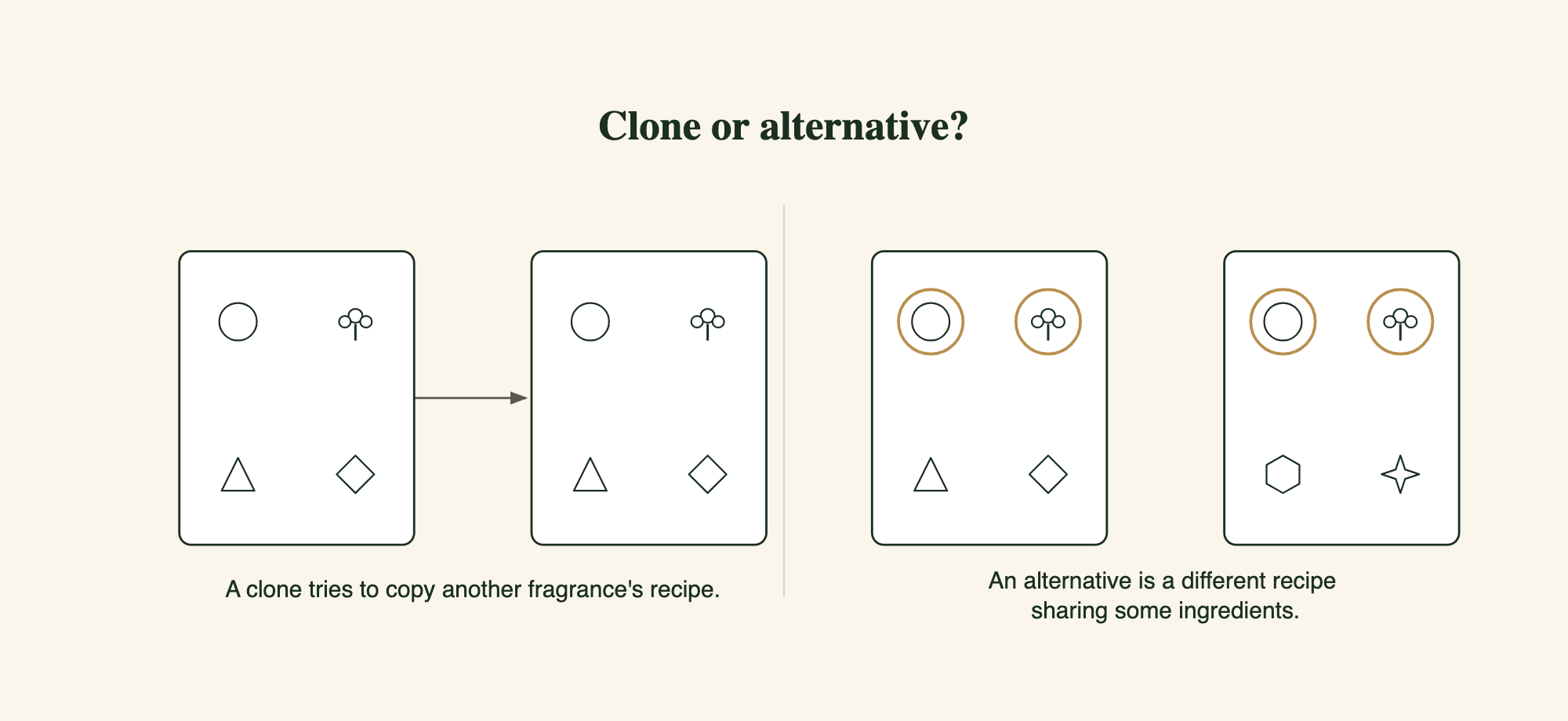
A fragrance is made from a recipe of smells. Dior's recipe for Sauvage includes bergamot, a citrus fruit, and lavender, a flower. A clone tries to copy someone else's whole recipe. An alternative is a different recipe, from a different maker, that uses some of the same smells. It can remind you of Sauvage without being a copy.
What does Dior Sauvage Eau de Parfum smell like?
Dior's page says the idea for Sauvage Eau de Parfum was taken from "the desert in the magical hour of twilight." The same page labels it "Citrus and Vanilla Notes."
Dior's page describes its notes, such as bergamot or vanilla, in three layers, and Creed's product pages give a tidy definition of each. Head notes, the layer this guide calls top notes, open a fragrance and create its first impression. Heart notes create its defining character. Base notes ground it. Our guide to top, heart and base notes shows how the three layers fit together on a page like Dior's.
This is how Dior lists Sauvage Eau de Parfum:
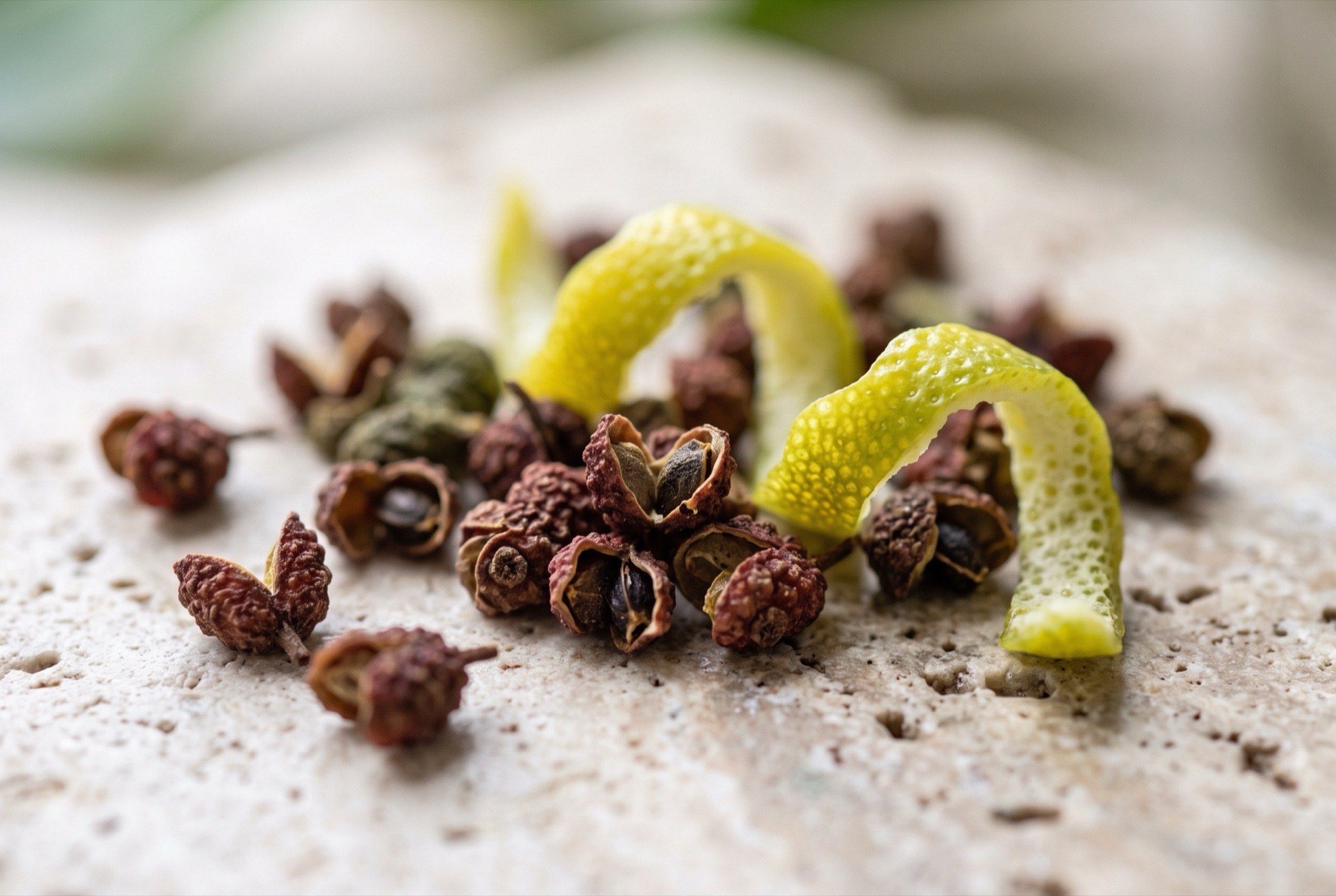
- Top: Calabrian bergamot. Dior says this bergamot "is fruitier than other bergamots and develops slightly peppery and zesty facets."
- Heart: Sichuan pepper, lavender and star anise.
- Base: vanilla extract from Papua New Guinea, which Dior describes as having "smoky accents," and ambroxan.
Ambroxan is the one name on that list that is not a plant or a spice. Wikipedia describes ambroxide, widely known by the brand name Ambroxan, as a material with woody, musky and slightly salty nuances. It is synthesized from sclareol, a component of the essential oil of clary sage.
WWD reported in September 2025 that the Dior Sauvage men's scent ranks first among all fragrances, masculine and feminine combined, 10 years after its launch, and that the Eau de Parfum arrived in 2018, after the Eau de Toilette.
What is the difference between a Sauvage alternative and a Sauvage clone?
PairFum, a perfume company that publishes a guide to copycat fragrance, defines a clone perfume as "a perfume that replicates, copies or imitates the scent of a well-known, popular and expensive luxury fragrance." PairFum treats clone, dupe, copycat, replica and even "similar scents" as words for the same thing, which is why this guide spells out what it means by an alternative.
NPR's reporting on dupes shows how that category presents itself. According to NPR, companies that make dupes openly advertise them as being "inspired by" more expensive fragrances, and these products are not knock-offs claiming to be the brand-name perfume. NPR adds that fragrance makers use gas chromatography-mass spectrometry, or GCMS, to identify the specific molecules in a competitor's fragrance, which NPR calls "a crucial step to creating a believable dupe." In plain words, Wikipedia describes GCMS as an analytical method that combines gas chromatography and mass spectrometry to identify different substances within a test sample.
An alternative, as this guide uses the word, is a separate fragrance from its own house, with its own published note list, that shares some notes or a note family with Sauvage. The Perfume Society sorts fragrances into families, including fresh, floral, woody and fougère. Two families matter here:
- Fougère. Wikipedia says the name comes from the French word for fern. The Perfume Society says fougère fragrances "almost invariably feature lavender, geranium, vetiver, bergamot, oakmoss and coumarin." Wikipedia describes oakmoss as derived from a species of lichen, and coumarin as similar to the scent of new-mown hay.
- Fresh. The Perfume Society says this family features notes such as "lemon, bergamot, orange, grapefruit, mandarin."
Dior's note list for Sauvage Eau de Parfum names two of those fougère materials, bergamot and lavender, and bergamot also belongs to the fresh group. No source in this guide calls Sauvage a fougère, and we do not either. Every pick below shares at least one named note with Dior's page.
This guide names no clone brands or clone products. It also makes no claim about how clones smell or how they compare with the fragrances they copy.
Which fragrances are like Dior Sauvage?
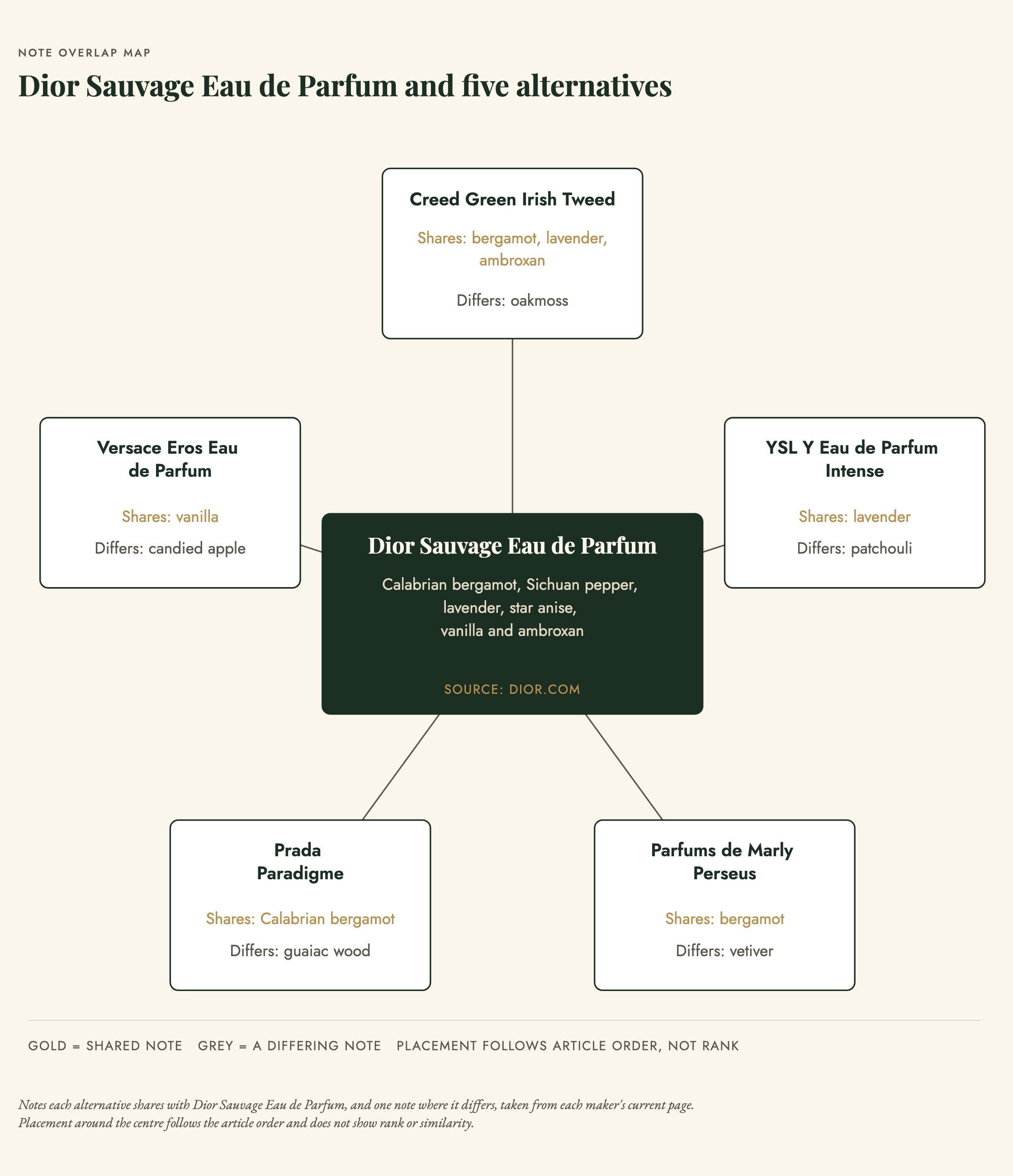
Five fragrances from five houses made this list. Each was chosen because its maker's current page names at least one note that Dior's page also names. The order is not a quality ranking. These picks come from fashion houses and perfume houses alike, and if that distinction is new, our explainer on designer versus niche fragrance covers it.
| Fragrance | Shares with Sauvage | Where it differs | Try it if... |
|---|---|---|---|
| Creed Green Irish Tweed | Bergamot, lavender, ambroxan | Peppermint and verbena on top, oakmoss in the base | You like the lavender in Sauvage and want green herbs around it. |
| YSL Y Eau de Parfum Intense | Lavender | Blue juniper berries and patchouli from Bali | Lavender is the part of Sauvage you notice most. |
| Parfums de Marly Perseus | Bergamot | Grapefruit and blackcurrant bud over vetiver | You want the citrus without the pepper and star anise. |
| Prada Paradigme | Calabrian bergamot | Peru balsam, benzoin resin and guaiac wood | You are curious about what Prada calls "the inverted fragrance pyramid." |
| Versace Eros Eau de Parfum | Vanilla | Mint oil and candied apple on top | The vanilla in Sauvage is what draws you in. |
Shared notes are read from both official pages, accessed September 14, 2026.
1. Creed Green Irish Tweed: green herbs around a familiar lavender
Imagine a herb garden with mint underfoot and a sprig of the same lavender you already know from Sauvage.
Smells like: Peppermint, verbena, lemon, bergamot and galbanum in the head notes; geranium, lavender and violet in the heart; sandalwood, cedarwood, ambroxan and oakmoss in the base. Creed files it under "Aromatic Fougère, Green & Mossy Woods" and writes: "Layers of fresh geranium are pitched against soothing lavender, while earthy oakmoss and woods entwine at the base, leaving a unique arboreal impression." Arboreal means tree-like. Source: Creed.
What it shares with Sauvage: Bergamot, lavender and ambroxan, three notes named on both official pages. Dior calls its bergamot Calabrian, while Creed lists plain bergamot.
Where it goes its own way: Oakmoss sits in the base. Peppermint, verbena, galbanum and violet are on Creed's list too, and none of them appears on Dior's. Creed calls it "a precision-crafted fougère from Creed," and four of the Perfume Society's six fougère materials are in its note list.
Wear it for: A slow walk through a botanical garden.
Shop the Creed Green Irish Tweed 5 ml atomizer
2. YSL Y Eau de Parfum Intense: lavender with juniper and patchouli
If lavender is what you notice first in Sauvage, here is a fragrance that keeps it and changes everything around it.
Smells like: YSL describes "a blend of blue juniper berries, fresh Diva lavender heart from Provence" alongside patchouli from Bali. Further down the same page, it also names French blue lavender, sage and geranium essence as part of the blend. Source: YSL Beauty.
What it shares with Sauvage: Lavender, and only lavender. YSL says where its lavender comes from; Dior's list simply says lavender.
Where it goes its own way: Patchouli from Bali and blue juniper berries, neither of which Dior names. The sage and geranium on YSL's page are missing from Dior's list as well.
Wear it for: Cooking dinner for friends at home.
Shop the YSL Y Eau de Parfum Intense 5 ml atomizer
3. Parfums de Marly Perseus: bergamot on a grapefruit and vetiver frame
Perseus begins with the same fruit Sauvage begins with, then takes the citrus somewhere else entirely.
Smells like: Bergamot and grapefruit as top notes, geranium and blackcurrant bud as heart notes, and vetiver, amberwood and grey amber as base notes. In the maker's words, "Perseus combines bright grapefruit, fresh geranium, and refined vetiver." Source: Parfums de Marly.
What it shares with Sauvage: Bergamot, which sits at the top of both note lists.
Where it goes its own way: There is no pepper, star anise or vanilla on the Parfums de Marly list. Vetiver takes the base instead, and grapefruit and blackcurrant bud arrive before it.
Wear it for: Whenever Saturday morning means the farmers' market.
Shop the Parfums de Marly Perseus 5 ml atomizer
4. Prada Paradigme: bergamot in a pyramid turned upside down
Prada built Paradigme around what it calls "the inverted fragrance pyramid," and says the composition opens with Peru balsam, benzoin resin and guaiac wood.
Smells like: Prada says the Eau de Parfum opens with Peru balsam, benzoin resin and guaiac wood. At the heart is a double geranium extract, which Prada calls aromatic, green and floral, and that heart "is illuminated by Calabrian bergamot and airy musks." Source: Prada.
What it shares with Sauvage: Calabrian bergamot, written in exactly the same words on both pages.
Where it goes its own way: Guaiac wood, Peru balsam, benzoin resin, geranium and musks are all absent from Dior's list. The structure differs too: Dior's page says Sauvage Eau de Parfum "opens with a burst of Calabrian bergamot," while Prada's page says its double geranium heart "is illuminated by Calabrian bergamot and airy musks."
Wear it for: An afternoon at an architecture exhibition.
Shop the Prada Paradigme 5 ml atomizer
5. Versace Eros Eau de Parfum: vanilla after a mint and apple opening
Vanilla is the reason this one is here: Sauvage and Eros Eau de Parfum both keep it in the base.
Smells like: Versace lists Italian lemon and mandarin, mint oil and candied apple on top; geranium flower, clary sage essence and AmberMax in the heart; and Atlas and Virginia cedarwood, vetiver, patchouli, sandalwood and vanilla in the base. The page describes "a unique note of candied apple" and says: "Decadent vanilla dares to flirt with leather in the final note." Leather does not appear in the note list itself. Source: Versace.
What it shares with Sauvage: Vanilla. Dior specifies vanilla extract from Papua New Guinea; Versace lists vanilla without an origin.
Where it goes its own way: Candied apple and mint oil open it, and cedarwood and patchouli share the base with the vanilla. None of those four is on Dior's list. Versace names AmberMax rather than ambroxan, and this guide does not treat the two as the same material.
Wear it for: Old friends and a board game on the kitchen table.
Shop the Versace Eros Eau de Parfum 5 ml atomizer
How do Dior Sauvage and Creed Aventus compare?
Creed Aventus is not one of the five picks, so it gets its own section here. Creed's page lists Calabrian bergamot, Sicilian lemon and a blackcurrant leaf accord in the head notes; a pineapple accord, pink pepper and a jasmine accord in the heart; and birch, patchouli and a musk accord in the base. Creed sums the scent up as "fresh Calabrian bergamot, smoky birch and an iconic pineapple accord."
Set beside Dior's list, one note matches word for word: Calabrian bergamot, at the top of both. Each page also names a pepper, but not the same pepper. Sauvage has Sichuan pepper in its heart and Aventus has pink pepper in its heart, so this guide does not count pepper as a shared note.
After the bergamot, the two lists part company. Pineapple, blackcurrant leaf, jasmine, birch, patchouli and musk appear on Creed's page and not on Dior's. Lavender, star anise, vanilla and ambroxan appear on Dior's page and nowhere on Creed's Aventus list.
Neither list settles which one is better; they show what each is built from, and your skin decides the rest. You can try the Creed Aventus 5 ml atomizer.
How can you try these side by side?
Compare two at a time. Put Sauvage on one wrist and a single alternative on the other, and save the rest for other days.
Before you smell anything, read both official note lists and find the note they share, whether that is bergamot, lavender, ambroxan or vanilla. Look for that note first. Then notice where the pair goes apart, such as the peppermint in Green Irish Tweed or the candied apple in Eros.
Smell both wrists again later in the day. Creed's pages describe head notes as the source of a fragrance's first impression and base notes as the layer that grounds it, so the first comparison you make may not be the one you settle on.
Keep a two-line note on your phone for each pairing, one line for what you noticed first and one for what you noticed later. Our guide to sampling before you buy a full bottle goes through the reasons to test first, and our explainer on why perfume smells different on different people covers why your notes may not match a friend's.
Frequently asked questions
What smells like Dior Sauvage but is not a clone?
Five separate fragrances, or colognes as many shoppers call them, from Creed, YSL, Parfums de Marly, Prada and Versace share notes with Sauvage Eau de Parfum on their makers' official pages. Creed Green Irish Tweed shares bergamot, lavender and ambroxan. YSL Y Eau de Parfum Intense shares lavender. Parfums de Marly Perseus and Prada Paradigme share bergamot, and Versace Eros Eau de Parfum shares vanilla. Each is its own composition with its own published note list.
What is the difference between a fragrance clone and an alternative?
PairFum defines a clone perfume as one that "replicates, copies or imitates the scent of a well-known, popular and expensive luxury fragrance," and treats dupe and copycat as the same thing. An alternative, as this guide uses the word, is a different fragrance with its own maker and its own note list that shares some notes or a note family with another fragrance.
Is a fragrance dupe the same as a fake?
Not as NPR describes the market. Its reporting says companies that make dupes openly advertise them as "inspired by" more expensive fragrances, and that dupes are not knock-offs claiming to be the brand-name perfume. Word use varies, though: PairFum lists knock-off fragrance among its synonyms for a clone.
Is Dior Sauvage or Creed Aventus better?
The official note lists cannot answer that, and this guide does not rank them. Both name Calabrian bergamot at the top. Aventus builds on a pineapple accord, birch, patchouli and a musk accord, while Sauvage lists Sichuan pepper, lavender, star anise, vanilla and ambroxan. Each names a pepper, though a different one. The fair way to choose is to wear one on each wrist on the same day and decide on your own skin.
What is the difference between Dior Sauvage and YSL Y Intense?
Lavender is the one note both official pages name. YSL builds Y Eau de Parfum Intense from blue juniper berries, lavender from Provence and patchouli from Bali, and also mentions sage and geranium. Dior's list for Sauvage Eau de Parfum has Calabrian bergamot, Sichuan pepper, star anise, vanilla extract from Papua New Guinea and ambroxan, none of which YSL names. Trying the two side by side shows what changes around the shared lavender.
What is ambroxan, and which of these alternatives contain it?
Wikipedia describes ambroxide, widely known by the brand name Ambroxan, as a material with woody, musky and slightly salty nuances, synthesized from sclareol, a component of the essential oil of clary sage. Dior lists ambroxan in the base of Sauvage Eau de Parfum. Of the five alternatives here, only Creed Green Irish Tweed lists it. Creed's Aventus page does not, and Versace lists AmberMax, a different name this guide does not treat as the same material.
Where should you start?
Set Dior Sauvage Eau de Parfum beside Creed Green Irish Tweed first, since, of the five picks in this guide, they are the pair with the most notes in common. Bergamot, lavender and ambroxan appear on both official pages, so the differences you notice come from what each adds: peppermint and oakmoss on one side, Sichuan pepper, star anise and vanilla on the other.
Our homepage describes what we sell as authentic designer and niche fragrance, decanted to a 5 ml spray, so you can try it on your skin before you buy the bottle. A decant, in the homepage's own definition, is authentic fragrance transferred from the original bottle into a smaller spray. One-time vials are the default and no subscription is required; Monthly Rotation is separate and optional. A single 5 ml atomizer of any fragrance named in this guide is $20 as a one-time purchase.
Sources
- Dior: Sauvage Eau de Parfum
- Creed: Green Irish Tweed
- YSL Beauty: Y Eau de Parfum Intense
- Parfums de Marly: Perseus
- Prada: Paradigme
- Versace: Eros Eau de Parfum
- Creed: Aventus
- NPR: why fragrance dupes are popular and how to buy them
- PairFum: should you buy perfume dupes and copycat fragrance?
- WWD: Dior Sauvage
- The Perfume Society: Fougère
- The Perfume Society: What is fresh?
- Wikipedia: Fougère
- Wikipedia: Ambroxide
- Wikipedia: Gas chromatography and mass spectrometry