
Disclosure first: we run Base Note, a luxury fragrance subscription that ships a 5 ml atomizer of designer and niche scents every month for a flat $20. Concentration is a commercial subject for us — every product page on our site carries a concentration badge, and our store default is Eau de Parfum. So we have an interest in you believing concentration matters. What follows is the honest version anyway, including the part where the published percentage ranges contradict each other, the part where the letters on the bottle predict less than you have been told, and the specific, common case where an Eau de Toilette outlasts an Eau de Parfum on the same person on the same day.
If you only read one thing: The EDT / EDP / Parfum labels describe how much fragrance concentrate is dissolved in the alcohol, and nothing else. Higher concentration usually means longer wear, so it is a reasonable tiebreaker between two bottles of the same scent. But it is a weak predictor on its own, because the published ranges overlap, no regulator enforces them, and the weight of the individual molecules in the formula matters more than the total percentage. A citrus-dominant EDP can vanish before a resin-heavy EDT. Read the note list first and the badge second.
The concentration ladder, and where the sources disagree
Every consumer guide publishes a version of this table. We fetched two of them and put the numbers side by side, because the disagreement is more informative than either source alone.
| Designation | Concentrate, per Ulta Beauty | Concentrate, per Wikipedia | Published longevity claims |
|---|---|---|---|
| Eau Fraîche | “around 1-3%” | “3% or less aromatic compounds” | Ulta: a “soft, fleeting aroma”; no hour figure given |
| Eau de Cologne (EDC) | “only 2-5% fragrance oil” | “2–3% aromatic compounds” | Wikipedia: “lasting around 2 hours” |
| Eau de Toilette (EDT) | “between 5-15%” | “5–15% aromatic compounds (typically ~10%)” | Wikipedia: “from 2 to 4 hours” |
| Eau de Parfum (EDP) | “around 15-20%” | “15–20% aromatic compounds (typically ~15%)” | Ulta: “typically lasting 6-8 hours on the skin” |
| Parfum / Extrait | “20-30%” | “15–30% aromatic compounds” | Ulta: “8-12 hours or more”; Wikipedia: perfume “may last up to six or even eight hours” |
(Sources: Ulta Beauty, fetched 18 August 2026; Wikipedia, “Perfume”, fetched 18 August 2026.)
Three things fall out of that table, and all three are worth more than the numbers themselves.
The ranges overlap. A 15% formula qualifies as an Eau de Parfum under both sources, as a Parfum under Wikipedia’s range, and sits at the top edge of Eau de Toilette. A brand choosing what to print on a box has real latitude at the boundaries, and it will choose the word that sells better.
The longevity claims disagree by a factor of two. Ulta puts Parfum at 8 to 12 hours or more. Wikipedia’s figure for perfume tops out at six to eight. Both are describing the same category. Neither is measuring anything; they are conventions written down.
No one is enforcing the definitions. These are industry conventions, not a regulated standard with a compliance test behind it. We could not find a US or EU rule that sets a minimum oil content for the phrase “eau de parfum,” and the fact that two mainstream reference sources publish different boundaries is itself the evidence. Treat the letters as a manufacturer’s claim about intent, not as a measurement.
What the words actually mean
A finished fragrance is a concentrate — the perfumer’s blend of naturals, aroma chemicals and accords — dissolved in a carrier, which in almost every commercial fragrance is denatured ethanol with a small amount of water. The designation on the bottle describes the ratio between those two things. That is the whole mechanism. An Eau de Toilette is not a lighter interpretation of a scent in any artistic sense; it is, in principle, more alcohol per spray.
The general relationship is real and worth stating plainly: “As the percentage of aromatic compounds increases, so does the intensity and longevity of the scent” (Source: Wikipedia, “Perfume”, 2026). More material on the skin takes longer to leave the skin. Nobody disputes the direction of the effect. The argument is only ever about how much it predicts in a specific case.
What concentration actually changes
1. Average longevity, across many fragrances
Compare a hundred EDTs against a hundred EDPs and the EDPs win on average wear time. That is genuinely useful when you are choosing between two versions of the same fragrance and have nothing else to go on. It is much less useful when you are choosing between two different fragrances, because the between-fragrance variation swamps the between-concentration variation. If longevity is the thing you actually care about, projection, sillage and longevity are three separate properties and concentration does not move them equally.
2. How many sprays you need
This is the underrated one. A higher concentration means each spray deposits more material, so you need fewer of them to reach the same intensity. Two sprays of a parfum can do the work of four sprays of an EDT. If you are working from a 5 ml atomizer — roughly 60 sprays — that difference decides whether the vial covers a fortnight or a month. We worked through the arithmetic in How Long Does a 5 ml Fragrance Atomizer Last?, and concentration is one of the two variables that moves the answer most.
3. What you pay per millilitre of actual fragrance
Parfum concentrations are usually priced higher per millilitre than the EDT of the same name, which on a per-millilitre-of-concentrate basis is often fair rather than exploitative. It does mean a full bottle’s sticker price is a poor guide to value until you know which version you are looking at.
What concentration does not change
It is not a quality grade
Parfum is not the premium edition and EDT is not the budget one. Some of the most admired fragrances in perfumery history were composed as Eaux de Toilette and are diminished when reformulated stronger. Concentration is a design decision about how a composition should sit on skin, in the same category as deciding how much bergamot to use. A brighter, more effervescent opening is a legitimate goal, and a lower concentration with more alcohol behind it is how you get one.
The stronger version is frequently a different fragrance
This is the single most common misunderstanding we hear from customers. When a house releases an Eau de Parfum alongside an existing Eau de Toilette, it is very often not the same juice at higher strength. It is a separate formula, composed to work at that concentration, sometimes with materially different notes. That is why people who love the EDT of something regularly dislike the EDP, and vice versa — a reaction that makes no sense if you believe the EDP is simply “more of it.” Before assuming the stronger version is an upgrade, compare the two note lists on the brand’s own site. They frequently do not match.
It tells you nothing about whether you will like it
Concentration predicts duration, weakly. It predicts enjoyment not at all. Every buying mistake we hear about — and the reason Base Note exists — is someone committing $200 to $500 to a bottle on the strength of an attribute that was never going to determine whether they wanted to smell like it. If you are early in that process, our case for sampling before you commit to a full bottle starts from the opposite end.
Why an EDT can outlast an EDP
Here is the mechanism, and it is not complicated once you stop thinking in percentages and start thinking in molecules.
The concentration figure is a total. It says how much material is on your skin, not what kind. Fragrance materials evaporate at wildly different rates depending on their molecular weight and structure. Small, light citrus and herbal molecules flash off in minutes. Heavy resins, musks, woods and vanillic materials cling for hours — base notes are conventionally “usually not perceived until 30 minutes after application” (Source: Wikipedia, “Perfume”, 2026), which is exactly the point: they are still arriving when the top notes have already gone.
So an EDP at 16% that is 70% bright citrus and airy musk has less staying material on your skin than an EDT at 12% built on tobacco, benzoin and vanilla. The percentage says the first bottle put more grams on your arm. The composition says most of those grams left in the first hour.
There is instrumented work pointing the same way. A 2025 study in the International Journal of Cosmetic Science semi-quantified fragrance evaporation directly from the skin of a group of volunteers, then measured each volunteer’s skin properties to account for the differences, with the stated aim of understanding “how both skin type and the intrinsic properties of fragrance molecules contribute to the observed variations in evaporation rates” (Source: Hadjiefstathiou et al., International Journal of Cosmetic Science, 2025, vol. 47 no. 6, pp. 981–995 — abstract free on PubMed, full text requires institutional access or purchase). Read that aim carefully, because it contains two inputs and not one: the molecule and the skin. A single percentage printed on a box captures neither of them.
Two more physical factors push in the same direction. Skin temperature raises vapour pressure non-linearly, since “the vaporization curves of most liquids have similar shapes with the vapor pressure steadily increasing as the temperature increases” (Source: LibreTexts, 2023) — so a hot day compresses a high-concentration fragrance’s timeline faster than a cool one. And skin oil behaves as a reservoir: “sebum, the waxy, lipid-rich substance produced by sebaceous glands, is the primary binding agent for fragrance molecules on skin” (Source: Premiere Peau, 2025, an industry rather than peer-reviewed source). Oilier skin holds heavy molecules longer; dry skin loses them early. Two people can wear the same EDP and honestly report a four-hour gap. We went through the whole of that in why you smell the way you do and, more specifically, why perfume smells different on you than on your friend.
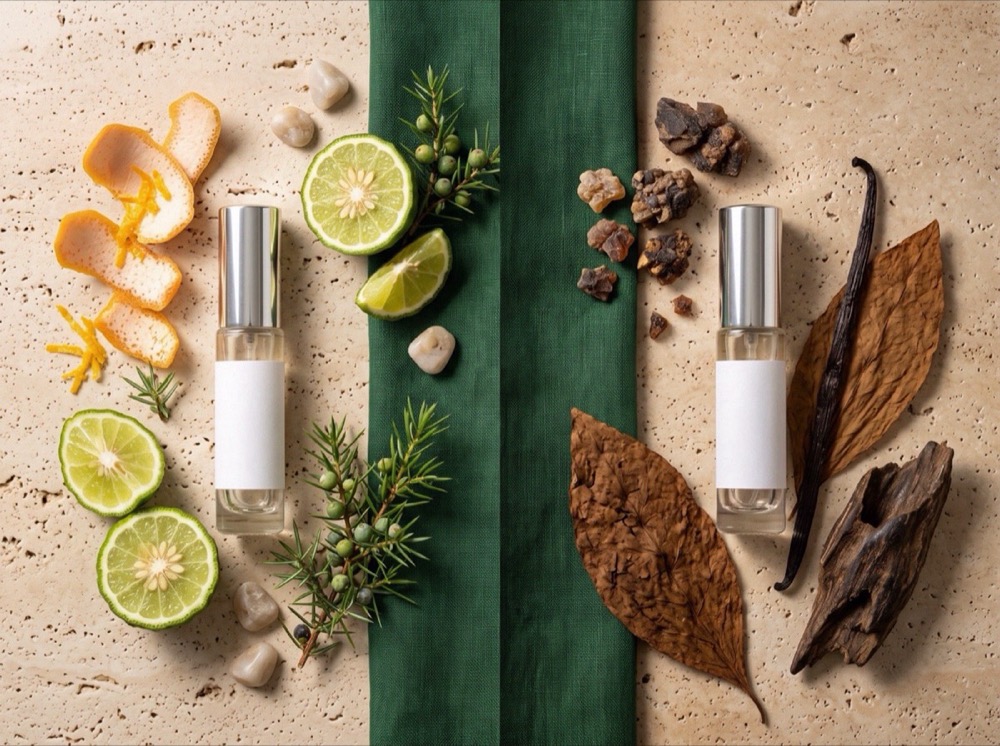
You can see the principle in our own catalogue without needing any lab equipment. Dolce & Gabbana Light Blue opens on grapefruit, bergamot, Sicilian mandarin and juniper and closes on musk, incense and oakmoss — a composition whose personality lives in its most volatile third. Viktor & Rolf Spicebomb Extreme runs lavender, black pepper, saffron and caraway into cinnamon, cumin and tobacco, and lands on vanilla, amber and pipe tobacco. Bvlgari Le Gemme Orom is bourbon vanilla, Siam benzoin and agarwood, top to bottom — essentially all base. Those three will not behave alike no matter what the badges say, and the note lists tell you that before the badges do. Our guide to reading a note pyramid is the companion skill here.
How Base Note labels concentration
Because the letters mislead when they are missing, we put them on every product page: directly under the fragrance title sits a concentration badge and the country of origin. Our store default is Eau de Parfum; anything that is not an EDP is marked as what it is rather than quietly defaulting. Acqua di Gio Profondo Parfum carries the parfum designation in its own name, and the badge follows the bottle we decant from rather than the house style.
That last clause is the part that matters. Every Base Note atomizer is decanted from the original retail bottle, so the concentration on the badge is the concentration you are wearing. We are not making our own dilution and calling it by the fragrance’s name. If the badge says Eau de Parfum, you are testing the same Eau de Parfum a department store would sell you at $200 to $500, in a 5 ml atomizer for a flat $20.
A decision table you can actually use
| Your situation | What to weight | Why |
|---|---|---|
| Choosing between the EDT and EDP of the same fragrance | Compare the two note lists first; if they match, take the EDP | Same composition at higher concentration is a real upgrade in wear time. Different composition is a coin flip. |
| Choosing between two different fragrances | Base notes, then concentration | Composition dominates. A heavy base at 12% beats a citrus opening at 18%. |
| Hot weather, office, close quarters | Lower concentration or fewer sprays of a higher one | Heat accelerates evaporation and amplifies projection. Strength is easy to add and impossible to remove. |
| You have dry skin and everything “disappears” | Heavier base notes before higher concentration | The lipophilic materials are the ones your skin is failing to hold. Add weight, not percentage. |
| Stretching a 5 ml atomizer across a month | Higher concentration | Fewer sprays per wear at the same perceived intensity. |
| You have no idea what you like yet | Ignore concentration entirely | It cannot tell you whether you want to smell like the thing. Test on skin. |
The honest summary
Concentration is a real variable with a real physical basis, and it is the single most abused shorthand in fragrance retail. The published percentages are conventions rather than measurements, they overlap at the boundaries, the two mainstream sources we fetched disagree on longevity by roughly a factor of two, and the letters on the box are a weaker predictor of how long something lasts on you than the note list underneath them and the skin you are putting it on.
Use it as a tiebreaker. Do not use it as a purchase reason. And whatever the badge says, the only way to know how a fragrance performs on your skin is to wear it for a full day — which is precisely the experiment that costs $200 to $500 when you run it by buying full bottles.
That is the problem we built Base Note to solve. One flat price. Every luxury fragrance. Build your signature rotation. Every month you get a 5 ml atomizer — roughly 60 sprays, enough for a genuine multi-week trial rather than a paper strip — from a rotation of 32 designer and niche fragrances including Creed, Tom Ford, Parfums de Marly, Xerjoff and Bond No. 9. It is a flat $20 a month, 25% off your first month at $15, swap monthly, cancel anytime. The concentration badge and country of origin are on every product page, so you can select for longevity deliberately instead of finding out after the money is gone. If you are not sure where to start, the quiz takes about two minutes, or you can just read the note lists yourself.
— Jeff Theefs & Alex Cherne, Founder & Cofounder, Base Note
```