
Direct answer: Oud smells deep, warm and woody, with a dry, incense-like smoke, a honeyed sweetness underneath and, at full strength, a leathery edge some people call barnyard. It comes from agarwood, the dark heartwood certain Aquilaria trees form after a mold infection. In the four fragrances on our ladder it arrives blended with spice, fruit, rose, vanilla or leather, so you meet it in company rather than alone.
Disclosure: Base Note sells 5 ml atomizers of every fragrance on the ladder in this guide and benefits if you shop through the product links. The selection reflects products that were available on Base Note on September 14, 2026. Note descriptions come from the linked manufacturer pages; the ladder placement and wearing advice are our editorial interpretation. We have not used unverified price, shipping, spray-count, or performance claims.
Oud is the note people argue about. One person wears it every cold evening; another smells it once on a paper strip and decides it smells like a stable. Both are usually describing the same material at different moments. A note, if the word is new, is one smell you can pick out inside a fragrance, such as cardamom or rose.
Explained simply
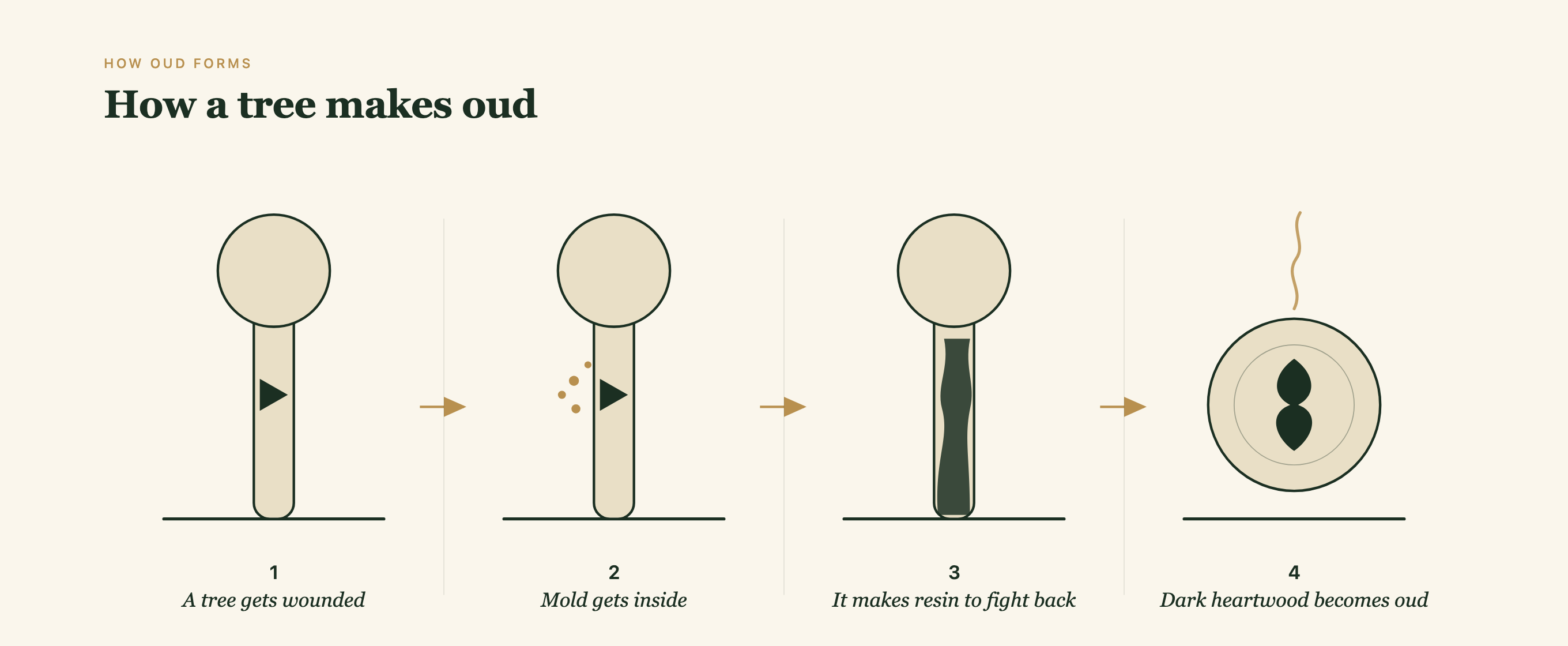
Some Aquilaria trees get hurt, and a mold gets into the wood. The tree fights back by making resin, a thick, sticky goo that protects it. Wood soaked in that resin turns dark and smells rich and smoky. That dark wood is oud. Before the mold arrives, the same wood barely smells of anything.
What is oud, and where does it come from?
Oud is one of several names for agarwood. A scientific review archived on PubMed Central lists agarwood, eaglewood, oud, aloeswood and gaharu as names for the same fragrant heartwood, produced by Aquilaria trees. Heartwood is the dense wood at the centre of a trunk. Of 21 Aquilaria species, it says, only 9 produce the resin.
That resin is a defence. According to the same review, agarwood forms when an Aquilaria tree is wounded and infected by fungi: the tree produces resin to fight back, and the wood changes from a lighter colour to a darker one. The Wikipedia entry on agarwood names a Phaeoacremonium mold, P. parasitica, while the review notes that fungi including Fusarium, Lasiodiplodia, Penicillium and Aspergillus have been found in agarwood-producing trees. Wikipedia adds that before infection the heartwood mostly lacks scent and is light and pale. As the infection advances, the wood turns dense, dark and saturated with resin.
International trade in agarwood is regulated. According to Wikipedia, the Convention on International Trade in Endangered Species of Wild Fauna and Flora (CITES) has listed Aquilaria malaccensis, the primary source species, in Appendix II, its list of potentially threatened species, since 1995, and all Aquilaria species since 2004. That listing means international trade in agarwood is monitored and subject to controls meant to keep harvesting and export from threatening the survival of the species. The PubMed Central review links the rarity of natural agarwood to overharvesting as demand has grown.
What does oud actually smell like?
Picture a dark wooden room where incense has burned, with a warm jar of honey open on the table. Wholly Kaw, a grooming brand that publishes a short guide to the material, describes oud as deep, warm and resinous, with a smoky, animalic, sweet-woody richness. Resinous means thick, sticky and slightly sweet, the way pine sap or incense smells. Three parts of that description are worth listening for:
- Smoke over wood. A dry smokiness, close to incense, sits on top of the wood.
- Sweetness underneath. Below the smoke is a honeyed, balsamic warmth. Balsamic describes smells that are soft, sweet and resin-like.
- An animal edge. At full strength, oud has a musky, leathery, slightly barnyard side. Perfumers call this animalic, meaning smells that recall skin, leather or animals.
If you know sandalwood, use it as a reference point. Wholly Kaw sets the two side by side: sandalwood is smooth and creamy, while oud is dense and complex.
In a finished fragrance you rarely meet oud first. Top notes are the bright smells you notice right after spraying, heart notes arrive as those fade, and base notes are the deepest layer, the one that stays last. On all four ladder fragrances, oud comes after the opening: Bond No. 9 lists its oud accord in the heart, Parfums de Marly and Xerjoff put oud in the base, and Tom Ford describes rosewood and cardamom giving way to oud. That is why an oud fragrance can smell like a different scent a little while after you spray it. Our guide to top, heart and base notes explains the layers in more detail.
Why do people love oud or hate it?
A frequent first reaction is that oud smells like a barnyard, and that is a fair description of part of it: Wholly Kaw itself describes a "musky, slightly barnyard or leathery edge" at full strength. The people who dislike it are describing it accurately and reacting to that edge differently.
Timing explains much of the split. Wholly Kaw notes that natural oud straight from the bottle can smell sharp, funky and animalic, which surprises people expecting something pretty, before the rawness settles into a warm, smoky, resinous wood. Someone who sniffs a paper strip at a counter and walks away has judged the opening. Someone who wore it through dinner is describing where it ended up.
The love case is that movement, which Wholly Kaw calls an evolution from challenging to comforting and a large part of why oud fascinates people. The hate case is the first impression, and some people never warm to the animalic side. Skin matters as well, which our explainer on why perfume smells different on different people covers.
Real oud or synthetic oud: what is in the bottle?
Start with a word you will see on oud labels: accord. An accord is a blend of several materials built to smell like one thing. According to Scento's guide to oud, the scarcity and cost of natural oud mean most oud-based fragrances today rely on synthetic oud accords, lab-made blends built from molecules such as Iso E Super, Cashmeran, Ambroxan and Kephalis.
The trade-off is about movement. Scento quotes Première Peau: natural oud oil contains more than 150 compounds that unfold on skin, while a synthetic accord captures one moment of that arc and holds it steady. Scento describes synthetic accords as consistent, but says they lack some of the complexity and dynamic character of natural oud, which keeps shifting on skin.
Western perfumery came to oud fairly recently. CaFleureBon, writing in 2013, dates the turning point to Yves Saint Laurent M7 in 2002, made under creative director Tom Ford with perfumers Alberto Morillas and Jacques Cavallier. Drawing on Michael Edwards' Fragrances of the World reference, it counted 27 fragrances with an oud note before M7 and 344 after it, as of 2013.
So what is in the four bottles on our ladder? We can only repeat each maker's words. Tom Ford writes of "rare oud notes" and "precious oud notes". Bond No. 9 lists an "Oud Accord". Parfums de Marly lists "Oud". Xerjoff lists "Laotian Oud". None of those phrases, on its own, tells you whether the oud is natural, synthetic or a mix, and we will not guess.
Why does oud feel right in fall?
Part of the answer is chemistry. The chapter on perfume in Neurobiology of Sensation and Reward, on the NCBI Bookshelf, describes base notes as large, heavy molecules that evaporate slowly. On every fragrance in the ladder below, oud sits in the heart or the base rather than the opening.
Temperature adds to it. Première Peau explains the physics through the Clausius-Clapeyron relationship: as temperature drops, vapor pressure drops and evaporation slows. Its example is limonene, the main molecule in citrus oils, which evaporates rapidly in heat and slowly in the cold.
The rest is mood, and this part is our editorial reading. Smoke and resin suit wool coats and early sunsets. Every fragrance on the ladder pairs its oud with something warm or sweet: Nomad and Alexandria II put vanilla in the base, Haltane builds its heart around praline, and Oud Wood uses tonka bean and amber for warmth.
How do four oud fragrances compare, from simplest to boldest?
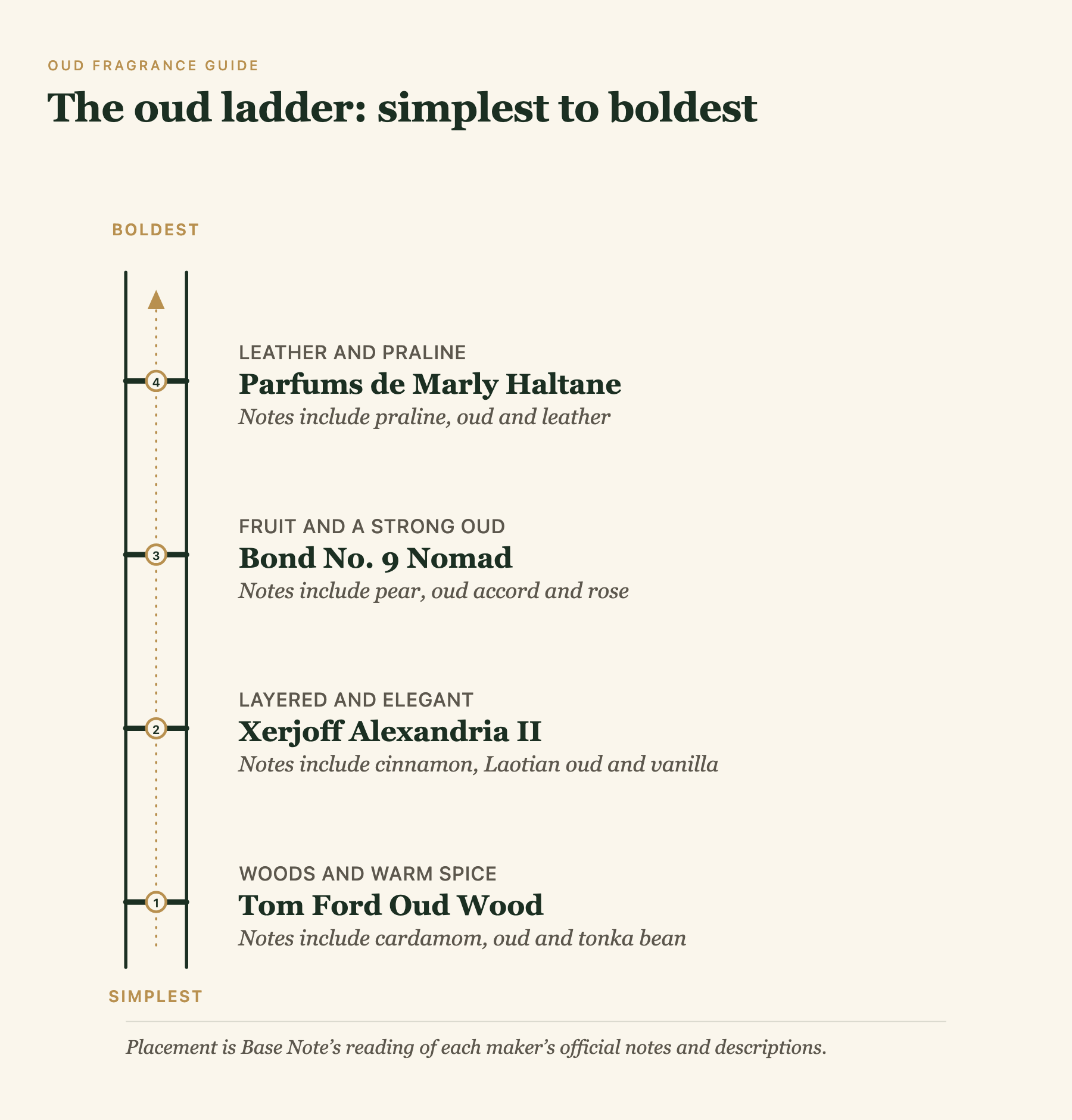
Each rung is placed using the notes around the oud and how its maker describes the scent. The simplest structure, oud with woods and warm spice, sits at the bottom; the two whose makers call them strong or powerful sit at the top. The ladder ranks how each blend is built and how its maker describes it, not how far a scent carries, and the placement is Base Note's reading of those pages, not a lab measurement.
| Rung | Fragrance | Official notes at a glance | Start here if... |
|---|---|---|---|
| 1. Woods and warm spice | Tom Ford Oud Wood | Rosewood, cardamom, oud notes, sandalwood, vetiver, tonka bean, amber (key notes also list pink pepper and patchouli) | You want oud with woods and warm spice, and no fruit, rose or leather around it. |
| 2. Layered and elegant | Xerjoff Alexandria II | Apple, cinnamon, lavender, rosewood; cedarwood, lily of the valley, Bulgarian rose; amber, Laotian oud, musk, sandalwood, vanilla | You want a longer, more layered blend, with the oud waiting in the base. |
| 3. Fruit and a strong oud | Bond No. 9 Nomad | Pear, quince, blackcurrant; violet leaves, oud accord, orris, rose; amber, sandalwood, vanilla | You like fruity or rosy scents and want an oud that is meant to be noticed. |
| 4. Leather and praline | Parfums de Marly Haltane | Bergamot, pink peppercorn; saffron, praline, lavender, clary sage; oud, patchouli, vetiver, leather | You want oud paired with leather, at the top of this ladder. |
The table summarizes manufacturer descriptions accessed September 14, 2026. A note list is a map, not a guarantee of how a scent will smell on you.
1. Tom Ford Oud Wood: the simplest oud here to read
Smells like: In Tom Ford's words, "Exotic rosewood and cardamom give way to a smoky blend of precious oud notes, sandalwood and vetiver. Tonka bean and amber add warmth and sensuality." Vetiver is a grass root with a dry, earthy smell; tonka bean is a seed with a warm, almond-like scent; amber in perfume is a warm, golden blend rather than one material. The key-note list also names pink pepper and patchouli. Source: Tom Ford Beauty.
Wear it for: A wool coat and a cool walk to dinner.
Where it sits on the ladder: Rung 1. The oud sits with rosewood, cardamom, sandalwood and vetiver, warmed by tonka and amber, with no fruit, rose or leather to decode at the same time. That makes it the simplest of the four to read, not the softest: Tom Ford says it uses "rare oud notes to overwhelm the senses with dark, earthy sensuality."
2. Xerjoff Alexandria II: the longest note list, with oud in the base
Smells like: Apple, cinnamon, lavender and rosewood on top; cedarwood, lily of the valley and Bulgarian rose in the heart; amber, Laotian oud, musk (a soft, skin-like smell), sandalwood and vanilla in the base. Xerjoff says it is "inspired by the ancient Arabian art of perfumery". Source: Xerjoff.
Wear it for: A dressed-up evening at the theatre.
Where it sits on the ladder: Rung 2, the richer step after Oud Wood. Its note list is the longest of the four, with spice, woods and rose to move through before the Laotian oud arrives in the base. Xerjoff sells it on "timeless elegance with a fresh, lively spirit" and never calls it strong or powerful, which is why it sits below Nomad.
3. Bond No. 9 Nomad: fruit and rose around a strong oud
Smells like: Pear, quince (a tart, perfumed fruit related to apple and pear) and blackcurrant on top; violet leaves, oud accord, orris (iris root, with a soft, powdery smell) and rose in the heart; amber, sandalwood and vanilla in the base. Source: Bond No. 9.
Wear it for: A night out when you want your scent to be part of the conversation.
Where it sits on the ladder: Rung 3. Bond No. 9 calls Nomad "a strong, sensual, statement-making oud". Fruit on top and amber, sandalwood and vanilla below frame that oud accord, which sits in the heart beside rose and orris instead of waiting in the base.
4. Parfums de Marly Haltane: praline and leather over oud, the boldest rung
Smells like: Bergamot and pink peppercorn on top; saffron, praline, lavender and clary sage (a garden herb) in the heart; oud, patchouli (an earthy leaf oil), vetiver and leather in the base. The maker describes a "subtle gourmand praline heart" that then intensifies "into the depth of oud". Gourmand means smells that recall food or sweets; praline is caramelised nuts. Source: Parfums de Marly.
Wear it for: A late evening in a leather jacket.
Where it sits on the ladder: Take away the vanilla and amber that warm the finish on rungs 2 and 3, put leather, patchouli and vetiver in the base instead, and you have rung 4. Parfums de Marly calls the result "audacious and powerful". The praline heart adds sweetness along the way, but leather stays in the finish; if leather scents are new to you, start lower on the ladder.
How do you wear oud without overwhelming a room?
Test at home first, on skin, and smell your wrist again later in the evening. The makers themselves describe these scents changing as they wear: Tom Ford has rosewood and cardamom giving way to oud, and Parfums de Marly has Haltane moving from a praline heart into the depth of oud. Judge the settled version before you wear it anywhere that matters.
Climb one rung at a time, moving up only when the one below feels familiar. Whichever rung you are on, start light and add more only after you have smelled it in the room you will actually be in. None of the four makers publishes projection figures.
Spray skin rather than a scarf, so the scent you judge is the one developing on you. Watch your sillage, the scent trail you leave in the air behind you: if someone can follow yours down a hallway, that is more than a closed room needs. Our explainer on projection, sillage and longevity separates those terms.
Wear one oud a day. Pairing Nomad with Haltane puts fruit, rose, vanilla, leather, praline and two lots of oud in competition for the same space.
Frequently asked questions
What does oud smell like in one sentence?
Oud smells like deep, warm, resinous wood, with a dry smoke close to incense, a honeyed sweetness underneath and, at full strength, a leathery, slightly barnyard edge. Resinous means thick, sticky and slightly sweet, like pine sap. In most fragrances you will not smell oud alone: makers blend it with woods, spice, fruit, rose or vanilla, which changes the first impression.
Is oud a good choice for a beginner?
Yes, if you start where the blend is simplest. Tom Ford Oud Wood surrounds its oud notes with rosewood, cardamom, sandalwood, vetiver, tonka bean and amber, with no fruit, rose or leather around it. Xerjoff Alexandria II is a richer next step, with amber, musk, sandalwood and vanilla around its oud. Save Bond No. 9 Nomad, which its maker calls a statement-making oud, and Parfums de Marly Haltane, which puts leather in its base, for later.
Is synthetic oud worse than real oud?
It depends what you want. Scento says most oud fragrances today rely on synthetic oud accords, lab-made blends built to smell like oud, because natural oud is scarce and costly. It describes those accords as consistent and affordable but lacking some of the complexity and dynamic character of natural oud, whose more than 150 compounds keep changing on skin.
Why does oud sometimes smell like a barnyard?
Oud forms when an Aquilaria tree is wounded and infected by fungi and makes resin to defend itself, and Wholly Kaw says that resin is dense with heavy aromatic compounds that give oud its smoky, animalic depth. At full strength that shows as a musky, leathery edge, and natural oud can open sharp and funky before settling into warm, smoky wood. Wholly Kaw notes that sandalwood usually softens and rounds oud out in a blend.
Can you wear oud outside fall and winter?
Yes. Season is a preference, not a rule. Oud feels at home in cool weather because, as Première Peau notes, dense woody materials such as agarwood lose little projection in cold air, and colder air slows evaporation. In warm weather, use less than you would in October and test it at home first.
Which oud fragrance should I try first?
Start with Tom Ford Oud Wood: its official notes pair oud with sandalwood and vetiver, warmed by tonka bean and amber, with no fruit, rose or leather around it. For more richness, move to Xerjoff Alexandria II, which adds rose, vanilla and musk. Bond No. 9 Nomad, a strong oud by its maker's own description, and Parfums de Marly Haltane, with leather, suit people who already enjoy oud.
Where should you start with oud?
The quickest way to learn whether oud suits you is to wear it on a few real days, starting at rung 1. Put on Oud Wood for an ordinary evening, notice how the opening compares with where it ends up, and move up only when the lower rung feels like something you would reach for again. Our guide to sampling before you buy a full bottle explains why that works.
That is what Base Note is for. We sell authentic designer and niche fragrance, decanted from the original bottle into a 5 ml spray, so you can try a scent on your own skin before you commit to the bottle. A one-time purchase is the default, with no subscription required, and anyone who wants a new vial each month can choose the optional Monthly Rotation and swap, skip or cancel from their account. A single one-time 5 ml atomizer of any fragrance on this ladder is $20.
Sources
- Tom Ford Beauty: Oud Wood Eau de Parfum
- Bond No. 9: Nomad
- Parfums de Marly: Haltane
- Xerjoff: Alexandria II
- PubMed Central: review of agarwood formation in Aquilaria
- Wikipedia: Agarwood
- NCBI Bookshelf: Perfume, in Neurobiology of Sensation and Reward
- Première Peau: why perfume behaves differently in cold weather
- Wholly Kaw: What does oud smell like?
- Scento: oud in perfume, natural and synthetic accords
- CaFleureBon: Yves Saint Laurent M7, where oud begins (2013)