
Disclosure first: we run Base Note, a luxury fragrance subscription that ships a 5 ml atomizer of designer and niche scents every month for a flat $20. We have an obvious commercial interest in you thinking about how you smell, so here is the honest version up front: nothing on this page is a fix for diet-driven body odour, and no fragrance we sell will overwrite it. Fragrance sits on top of your own smell. It does not replace it. What follows is what the published research actually says — including the part where the most famous villain in the story, garlic, appears to have been wrongly convicted.
If you only read one thing: Sulfur is the mechanism. Garlic, onions, cruciferous vegetables and a few spices carry sulfur-bearing compounds that survive digestion, enter the bloodstream, and leave through your skin and breath for hours afterwards — garlic's allyl methyl sulfide peaks in skin emission about 30 minutes after eating and is still elevated at 8 hours (Source: Scientific Reports, 2020). But "detectable" and "unpleasant" are different claims: in controlled odour-rating experiments, red meat made men smell measurably worse to raters, while garlic made them smell better. Before an evening that matters, the lever worth pulling is timing — not a heavier spray.
How food reaches your sweat in the first place
The path is unglamorous and short. You digest a food, some of its volatile compounds are small enough to cross into your bloodstream intact, blood circulates everywhere including the dermis, and those compounds diffuse out through skin and get exhaled through the lungs. They are not "sweated out" by a hard workout. They leave continuously, whether you are sweating or not.
Cleveland Clinic's gastroenterologist Christine Lee describes the spice version of this plainly: curry and cumin "contain volatile compounds that can be absorbed into your bloodstream and released through your sweat glands, leading to a distinct odor" (Source: Cleveland Clinic, 2024). That is the whole mechanism, and it applies to every food on this page.
There is a second, separate route, and conflating the two is where most articles on this subject go wrong. Some foods do not smell on their own — they change what your skin bacteria have to work with. Cleveland Clinic on red meat: "it can release odorless proteins through perspiration. But when these proteins mingle with skin bacteria, their odor intensifies." Body odour is manufactured by bacteria, not secreted ready-made — the subject of Sweat Doesn't Actually Smell and the foundation of the why you smell the way you do pillar.
One irony to sit with before blaming any vegetable: the most pungent molecules in human underarm odour are thioalcohols — sulfur compounds your own bacteria build from odourless precursors you secrete. Researchers showed in 2020 that a single bacterial enzyme is "both necessary and sufficient for thioalcohol formation," and that its gene arrived in odour-forming staphylococci roughly 60 million years ago (Source: Scientific Reports, 2020). Food does not introduce sulfur to your armpits. It adds to a sulfur process already running.
The short version
| Food | What carries the smell | Where it exits | Roughly how long | What actually helps |
|---|---|---|---|---|
| Garlic | Allyl methyl sulfide (AMS), diallyl disulfide (DADS) | Skin and breath | Skin emission peaks ~30 min after eating; still elevated at 8 h | Timing. Not scrubbing. |
| Onions | Sulfur compounds | Breath, then skin via apocrine sweat + bacteria | Hours; breath is the louder channel | Treat breath and skin as separate jobs |
| Cruciferous veg (broccoli, cabbage, Brussels sprouts, cauliflower) | Sulfuric compounds released in digestion | Sweat, breath, gas | Hours, dose-dependent | Portion size, not elimination |
| Red meat | Odourless proteins that skin bacteria then work on | Skin, via the microbiome | Measured over weeks of diet, not one dinner | Fewer meat-heavy days in the run-up |
| Spices (curry, cumin, fenugreek) | Volatile compounds absorbed into the bloodstream | Sweat glands | Hours to a couple of days at high intake | Time. It fades on its own. |
| Alcohol | Metabolised to acetic acid | Skin pores and breath | Through the night and into the morning | Water and sleep. No shortcut. |
Compounds and exit routes from Cleveland Clinic (2024); garlic timing from Scientific Reports (2020); red meat timescale from Chemical Senses (2006).

Garlic and onions: the sulfur problem
Garlic is the best-documented food on this list because someone finally measured it at the skin rather than the mouth. A 2020 study in Scientific Reports put gas collection cells directly on skin after volunteers ate grilled garlic. Diallyl disulfide rose immediately. Allyl methyl sulfide behaved differently: "the dermal emission flux of AMS reached a peak at 30 min after ingestion, and then gradually decreased," and the authors concluded that "the body odour caused by DADS and AMS lasted for at least 8 hours after intake of grilled garlic" (Source: Scientific Reports, 2020).
Eight hours from the skin, not the mouth. That is why brushing your teeth after a garlic-heavy lunch solves one channel and leaves the other running.
Now the part that almost never makes it into articles like this one. Czech researchers ran three experiments testing whether garlic actually makes people smell worse to other people. Forty-two male odour donors wore axillary pads for 12 hours on a garlic condition and again on a non-garlic condition, and 82 women rated the samples blind. Study 1 found nothing. But "the odour of donors after an increased garlic dosage was assessed as significantly more pleasant, attractive and less intense (study 2), and more attractive and less intense in study 3." The authors' conclusion: "garlic consumption may have positive effects on perceived body odour hedonicity" (Source: Appetite, 2016).
Both things are true. Garlic's sulfur compounds demonstrably leave your skin for eight hours, and blind raters preferred the smell of the men producing them. We are not going to tell you to eat more garlic before a date on the strength of one group's three experiments — but we will not repeat a stereotype the only direct evidence contradicts. Garlic breath is a separate, much better-founded complaint.
Cruciferous vegetables
Broccoli, cabbage, Brussels sprouts and cauliflower "release sulfuric acid," and that scent "is intensified by sweat, breath or gas" (Source: Cleveland Clinic, 2024). Same chemistry family as garlic, less studied at the skin, proportional to how much you ate.
Our honest read: this is the weakest entry to act on. You would be trading vegetables with well-established health value against a few hours of a smell nobody has measured at the skin. If you have a wedding on Saturday, skip the Friday slaw. Otherwise, eat the broccoli.
Red meat: the strongest evidence on this page
This is the finding that should change behaviour, and it is not about a single steak. Havlicek and Lenochova put 17 male odour donors on a "meat" or "non-meat" diet for two weeks, collecting axillary odour on pads during the final 24 hours, then repeated the whole thing a month later with each man on the opposite diet. Thirty women rated the samples. "The odour of donors when on the non-meat diet was judged as significantly more attractive, more pleasant, and less intense" (Source: Chemical Senses, 2006).
Two things to take from that design. It is a real perceptual effect on real human raters, not a chemistry-paper inference. And the exposure was two weeks — nothing in the study licenses the claim that Tuesday's burger is detectable on Wednesday. If red meat is a lever for you, it is one you pull over days.
Spices, and why cumin is a special case
Curry and cumin carry volatile compounds absorbed into the bloodstream and released through sweat glands (Source: Cleveland Clinic, 2024). Cumin gets its own paragraph because it is not only a food — it is a fragrance note, and a classic descriptor perfumers use for human skin itself. Xerjoff's Alexandria II lists cinnamon in its opening alongside apple, lavender and rosewood. Viktor & Rolf's Spicebomb Extreme puts cumin in the heart with cinnamon and tobacco.
Both are excellent. Neither is the one to wear on the evening of a cumin-heavy meal, because you would be stacking the same note on both sides of your skin. Not a flaw in the perfume — a scheduling problem.
Alcohol
"Alcohol is metabolized into acetic acid, which is released through your skin's pores, as well as your breath" (Source: Cleveland Clinic, 2024). Most people have personally verified this at 8am the morning after. Water and time are the only real interventions; spraying more fragrance over it produces something worse than either input.
The 24-hour timeline before an evening that matters
| When | What to do | Why, specifically |
|---|---|---|
| Several days out | Ease off meat-heavy days | The meat effect was measured over a two-week exposure, not one meal (Chemical Senses, 2006) |
| Night before | Moderate the alcohol; drink water | Acetic acid leaves through skin and breath and does not respond to grooming |
| Same day, 8+ hours before | Last window for a garlic-forward meal if you want it clear | Skin emission remains elevated at 8 hours (Scientific Reports, 2020) |
| 2 hours before | Shower, dry fully, wear cotton if it will be warm | Polyester smelled significantly less pleasant and more intense than cotton after identical exercise (Applied and Environmental Microbiology, 2014) |
| 20–30 min before | Apply fragrance, then leave it alone | You go partially nose-blind to your own scent fast, and re-spraying is how people over-apply |
| At the door | Do not add a second layer | More fragrance over a strong food signature makes a third smell, not a cleaner one |
The clothing line deserves its own note, because it is the cheapest fix here and nobody mentions it. Researchers collected T-shirts from 26 people after an intensive spinning session and had a trained odour panel assess them: "The polyester T-shirts smelled significantly less pleasant and more intense, compared to the cotton T-shirts," and micrococci — a malodour-associated genus — "were isolated in almost all synthetic shirts" (Source: Applied and Environmental Microbiology, 2014). Same body, same sweat, different fabric, different result.
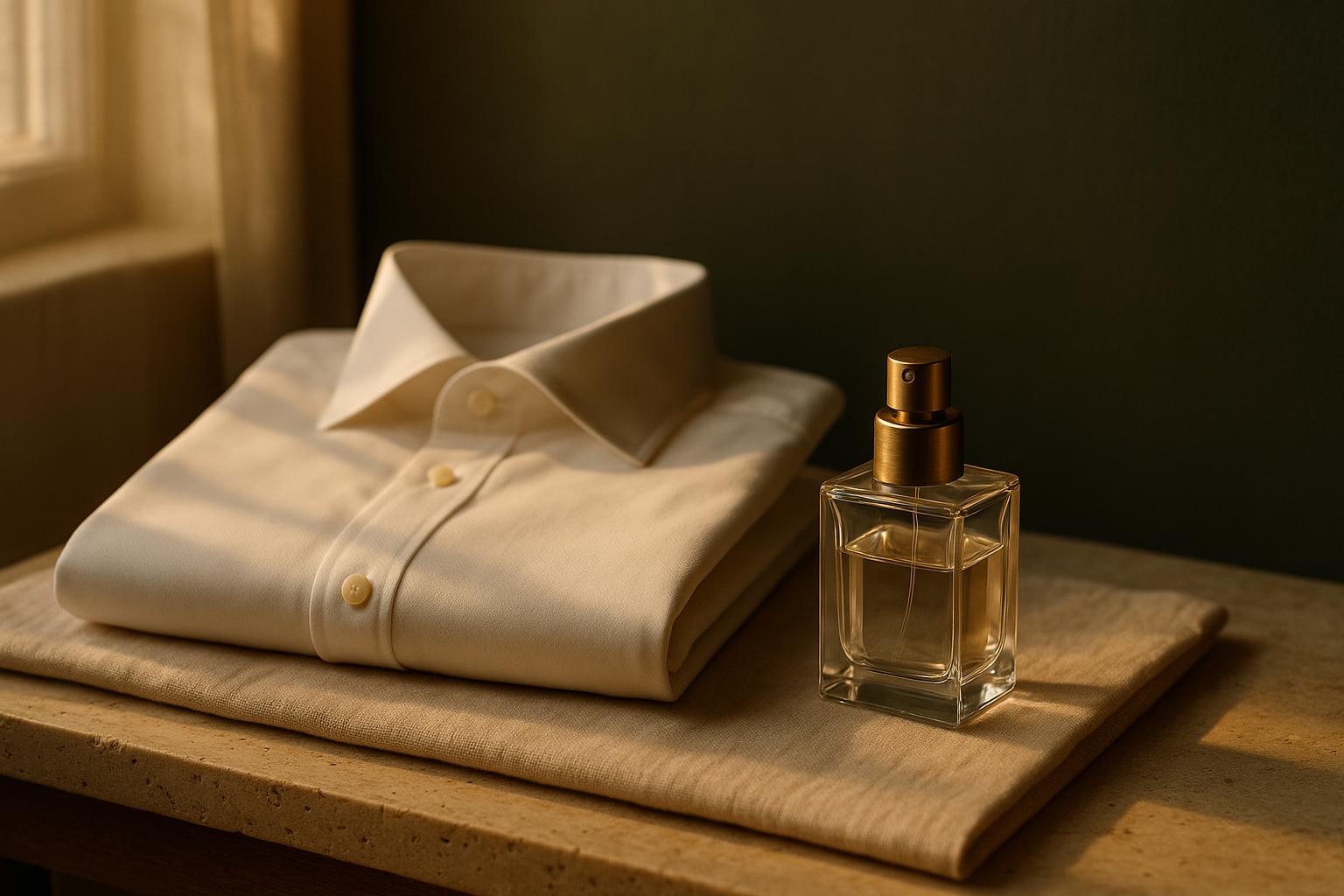
What to wear over a sulfur-leaning day
Perfumers have a conventional answer to a pungent, sulfur-leaning skin signature, and it is contrast rather than volume: a bright citrus-green opening over a clean or mossy base. That is craft convention, not laboratory science — but it is the structural logic behind the chypre, and it is the direction we would go. From the Base Note rotation, the picks that fit that shape:
- Creed Silver Mountain Water — bergamot and mandarin over green tea and blackcurrant, landing on musk, petitgrain, sandalwood and galbanum.
- Xerjoff Torino 21 — mint, lemon, basil and thyme up top, lemon verbena and musk underneath. Herbal-green and genuinely clean.
- Dolce & Gabbana Light Blue — grapefruit, bergamot, Sicilian mandarin and juniper over an oakmoss base. The closest thing in our catalogue to the classic bright-over-mossy structure.
- Acqua di Gio Profondo — sea notes and green mandarin into rosemary, lavender and cypress, then mineral notes and musk.
- YSL Y Intense — ginger and bergamot over sage and geranium, drying to vetiver, patchouli and cedar.
What we would skip that day: the heavy spice orientals. Spicebomb Extreme runs cumin, cinnamon and tobacco, and Alexandria II leans into cinnamon and oud — congruent to a fault when your skin is already going that way. Save them for a clean-slate evening, where they are superb. For why the same bottle behaves differently on different people, see Why Does Perfume Smell Different on Me; for when each note appears, Fragrance Notes Explained.
The nuance nobody mentions
Detectable is not the same as unpleasant. This is the thread running through the whole piece. Garlic's sulfur compounds are measurable at the skin for eight hours and blind raters still preferred the smell of the men eating it. Red meat produced no identified molecule in the study that condemned it, and raters still marked it down. The nose is not a gas chromatograph.
Effect sizes here are small. Every study on this page found statistically significant differences under controlled conditions with trained or blinded panels. None describes a smell that walks into a room. If you are worried people can smell last night's curry from across a table, the evidence does not support the worry.
Fragrance sits on top; it does not overwrite. Peer-reviewed work on perfume and body odour finds the two form a combined, individually specific smell rather than one erasing the other. So the goal is not to out-shout your diet. It is to put something over it that is going in a different direction. If you already know your skin runs oily and amplifies whatever it is given, our note-level guide for that is Best Fragrance Notes for Oily Skin.
Some odours are medical, not dietary. A persistent fishy smell in breath, sweat or urine, unusually sweet or nail-polish-like breath, a foul smell from a skin fold, or any sudden change with no change in diet — those are questions for a doctor, not a shopping list. Trimethylaminuria, for one, is an inherited metabolic condition and no perfume addresses it. Talk to a clinician rather than reaching for a stronger spray.
The bottom line
Sulfur is real, the route from bloodstream to skin is real, and the timings are known well enough to plan around: about eight hours for garlic, a night for alcohol, weeks rather than hours for a meat-heavy diet. Everything past that is smaller than the internet suggests, and one of the classic villains was acquitted the moment anyone ran a controlled test.
The practical takeaway is unglamorous. Plan the day, not the spray. Wear cotton. Shower and dry properly. Apply once, half an hour ahead, then trust it. And choose something structurally opposed to what your skin is already doing rather than something that piles onto it.
That last part is the bit we can help with. Working out which fragrances suit your own chemistry takes wearing them for a few days each — exactly what full bottles make expensive and slow. A Base Note subscription is one 5 ml atomizer, roughly 60 sprays, from the 32 fragrances in the rotation, every month, for a flat $20. Same price whether you pick the Creed or the Armani. Swap monthly, cancel anytime, first month 25% off. One flat price. Every luxury fragrance. Build your signature rotation.
Not sure where to start? The scent quiz takes two minutes, or browse the full rotation and pick the one that argues with your week.
— Jeff Theefs & Alex Cherne
Founder & Cofounder, Base Note