
Disclosure first: we run Base Note, a luxury fragrance subscription that ships a 5 ml atomizer — roughly 60 sprays — of designer and niche scents every month for a flat $20. We carry 32 fragrances from houses including Creed, Tom Ford, Parfums de Marly, Xerjoff and Bond No. 9, and we obviously benefit if you decide the answer to your fragrance problem is “try more fragrances.” So here is the uncomfortable part up front: most of what circulates online about oily skin and perfume is fragrance-industry convention, not published science. We will show you exactly where the evidence stops and the craft knowledge starts, and you can decide how much weight to give each.
If you only read one thing: Oily skin is not a fragrance problem. It is an amplifier. Skin oil binds fragrance molecules and lets them go slowly, so heavy, sweet materials — vanilla, tonka, praline, caramel, thick amber, jammy fruit — tend to read louder and sweeter on you than the perfumer intended, sometimes by lunchtime. Materials with structure rather than sugar — citrus, green notes, herbs, tea, iris, vetiver, pepper and dry woods — hold their shape. If your fragrances keep turning syrupy on you, the fix is usually a note change, not a brand change, and occasionally just two fewer sprays.
The at-a-glance version
| Note family | What oily skin tends to do to it | Wear it when | In the rotation |
|---|---|---|---|
| Citrus & green (bergamot, grapefruit, lemon, verbena, violet leaf, galbanum) | Holds shape. Astringent brightness pushes back against the sweetness oil adds | Daytime, office, heat, anything you need to stay crisp | Silver Mountain Water, Light Blue, Torino 21 |
| Herbs & tea (rosemary, thyme, basil, sage, mint, green tea) | Holds shape. Almost nothing here for skin oil to turn sugary | Warm weather, long days, close quarters | Torino 21, Y Intense |
| Iris & pepper (orris, black/pink/Sichuan pepper) | Holds shape. Cool and dry rather than sweet-powdery | Anytime you want presence without volume | Green Irish Tweed, FiDi |
| Dry woods & vetiver (vetiver, cedar, cypress, guaiac) | Lasts longer than average, but keeps its texture | Evening, autumn, work | Y Intense, The Scent of Peace |
| Vanilla & gourmand (vanilla, tonka, praline, toffee, caramel) | Amplifies most. Sweetness compounds through the day | Cold weather, evenings, and with fewer sprays | Althair, Stronger With You Intensely, Bleecker Street |
| Jammy fruit & heavy amber (candied fruit accords, benzoin, thick amber, resins) | Amplifies. Can tip from rich to syrupy | Winter, short wears, one spray | Erba Pura, Le Gemme Oròm |
Why oily skin amplifies
From a fragrance molecule’s point of view, your skin is a warm, slightly acidic, lipid-covered surface. All three properties matter.
The lipid layer is sebum, produced by sebaceous glands under androgen control. As StatPearls puts it, “Androgens regulate sebaceous gland function through binding to nuclear androgen receptors… androgens stimulate cell proliferation and lipogenesis,” and the enzyme driving that is “abundantly produced in the sebaceous glands, especially sebaceous glands found on the face and scalp” (Source: StatPearls, Physiology, Sebaceous Glands). That is the physiological reason oily skin is a real, measurable skin type and not a grooming failure. It is also why sebum output varies enormously from person to person, and across your own face and body.
Most fragrance materials are oil-soluble. Put an oil-soluble molecule on an oily surface and it dissolves into the film rather than sitting on top of it. The fragrance industry’s version of this is blunt: “Sebum, the waxy, lipid-rich substance produced by sebaceous glands, is the primary binding agent for fragrance molecules on skin” (Source: Première Peau, 2025). Treat that as trade knowledge rather than a citation — it is a fragrance company writing about fragrance — but the chemistry behind it is uncontroversial. Like dissolves like.
The second property is acidity. Healthy skin sits on the acid side of neutral: a 2022 review in PLoS Pathogens reports that “recent investigations measuring skin surface pH in healthy volunteers report an average pH between 4.1 and 5.8” (Source: Costa & Horswill, PLoS Pathogens, 2022). That range is wide, and it moves. A 2017 observational study and literature review found “a difference in physiology of skin between men and women across all age groups, mostly with a pH value below 5 in men and above 5 in women,” and that “excessive perspiration due to heavy exercise and prolonged exposure to thermal environment could increase skin pH” (Source: Journal of Clinical and Aesthetic Dermatology, 2017). So the surface your fragrance lands on is chemically different from your friend’s, and different from your own after a gym session.
The third is heat. Warm skin evaporates volatile molecules faster, so oily and warm is the combination that produces the classic complaint: top notes burn off quickly, then the heavy base material sits in the sebum layer, releasing slowly, all afternoon, sweeter each hour.
We have written the full mechanism — oil, pH, heat, bacteria, hormones — in Why You Smell the Way You Do, and the person-to-person version in Why Does Perfume Smell Different on Me Than on My Friend?.
Notes that hold their shape
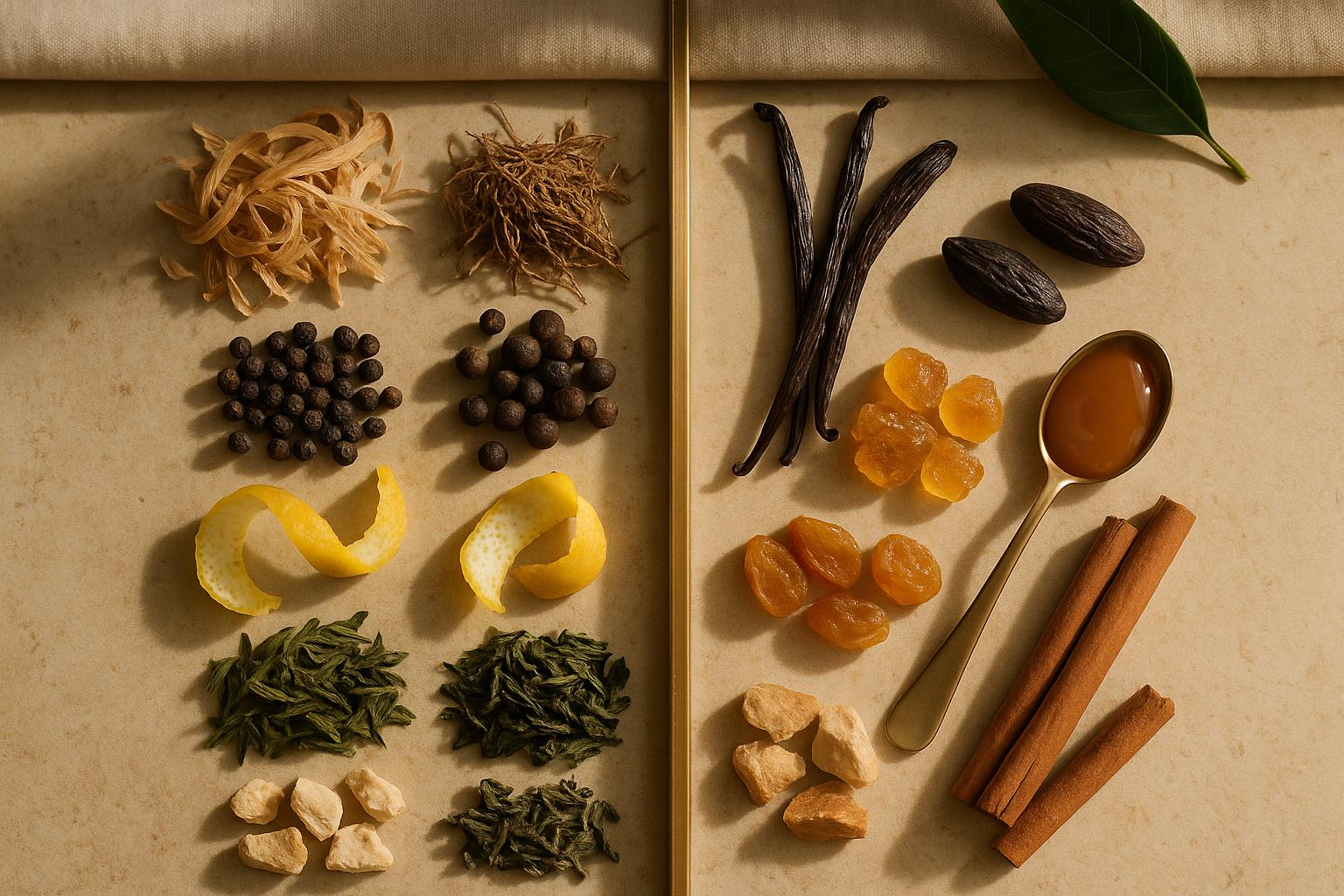
The pattern across every note that behaves well on oily skin is the same: structure rather than sugar. Something dry, sharp, bitter or green that gives the composition a spine as skin oil turns up the volume.
Citrus and green
Bergamot, grapefruit, lemon, mandarin, verbena, violet leaf, galbanum. These are astringent — clean and slightly bitter, exactly the counterweight to the roundness oil adds. Their weakness is that they are the most volatile materials in a fragrance and disappear first, but on oily skin they hang on longer than they would on dry skin. That is the one place oiliness works squarely in your favour.
Herbs and tea
Rosemary, thyme, basil, sage, mint, green tea. Aromatic materials carry almost no sweetness to begin with, so there is very little for sebum to amplify in the wrong direction. Green tea in particular reads dry and tannic, and stays that way.
Iris
Iris (orris) is the quiet answer for a lot of oily-skin wearers. It is powdery without being sweet — cool, rooty, faintly metallic. Where vanilla-powder accords get gauzier and sweeter as the day goes on, iris tends to hold its temperature.
Vetiver, dry woods and pepper
Vetiver, cedar, cypress, guaiac wood, and black, pink or Sichuan pepper. These are the base notes for people whose base notes usually run away with them. They are heavy enough to last on skin — and yes, oily skin will make them last longer still — but they are texturally dry, so “more of it” does not mean “sweeter.”
Notes that go syrupy
Honest framing, because this is where most articles get preachy: nothing here is off-limits. These are simply the materials with the widest gap between what they smell like in the first ten minutes and what they smell like on oily skin four hours later.
- Vanilla, tonka bean and benzoin. The classic amplifiers. Sweet, lipid-friendly, slow to leave.
- Praline, toffee and caramel accords. Gourmand materials are designed to read edible. On oily skin they can read very edible.
- Jammy and candied fruit. A fruit note that starts fresh can drift toward stewed as it warms and lingers.
- Thick amber and heavy resins. Not sweet exactly, but dense and enveloping, and they do not fade politely.
- Warm bakery spices. Cinnamon, cumin and cassia stack on top of an already-warm base.
If you love those notes — and plenty of people with oily skin do, deliberately, because the amplification is free longevity — the adjustment is dose and season, not abstinence. One spray instead of three, cold months instead of August, clothing instead of neck. More on that below.
What the evidence does and does not support
This topic is full of confident numbers that do not survive checking, so here is the line.
Well supported: skin pH sits in a measured range of roughly 4.1–5.8 and varies by person, sex and activity (PLoS Pathogens, 2022; J Clin Aesthet Dermatol, 2017). Sebum production is androgen-driven and varies by body site (StatPearls). And fragrance genuinely behaves as an individual blend rather than a mask: in a 2012 PLoS One study, “the odor blends with the participants’ own perfume were rated significantly more attractive and pleasant than blends with the assigned perfume,” even though the perfumes were rated equally pleasant on their own (Source: Lenochová et al., PLoS One, 2012).
Not supported, and we are not going to pretend otherwise: we could not find a peer-reviewed study quantifying how much longer fragrance lasts on oily skin. The specific hour counts you will see quoted around the internet trace back to marketing copy, not measurement. The mechanism is sound and the perfumers we buy from all work with it, but “oily skin holds scent longer” is craft consensus, not a finding. Anyone giving you a percentage is guessing.
And one medical note: if your skin oiliness is sudden, painful, or coming with persistent acne or an odour that soap does not touch, that is a conversation with a doctor or dermatologist, not a fragrance decision. Perfume sits on top of skin health. It does not manage it.
How to test on your own skin
Because the blend is individual, the only test that settles anything is your own. Four rules:
- Never judge on paper. A blotter has no sebum, no pH and no body heat. It will tell you what the perfumer made and nothing about what you will smell like at 4pm.
- Judge at the four-hour mark, not the four-minute mark. On oily skin the divergence from the bottle happens in the dry-down. Spray in the morning and form your opinion after lunch. Our guide to top, heart and base notes explains what is happening at each stage.
- Ask someone else. You go partially nose-blind to your own fragrance within the hour. The person across from you does not.
- Run one fragrance for a full month before deciding. Different weather, different clothes, different days. A scent that behaves in October may not in July — see our hot-weather guide for why.
Five picks from the catalogue
All five are in the rotation at the same flat $20, built around materials that keep their structure as skin oil warms them. The actual note pyramids are listed so you can check our reasoning rather than take it.
| Fragrance | Key notes | Why it works on oily skin |
|---|---|---|
| Creed Silver Mountain Water | Bergamot, mandarin / green tea, blackcurrant / musk, petitgrain, sandalwood, galbanum | Green tea and galbanum are the safeguards. Both are dry and slightly bitter, so the composition stays cool even as the base holds on |
| Xerjoff Torino 21 | Mint, lemon, basil, thyme / blackcurrant, lavender, rosemary, jasmine / lemon verbena, musk | Herb-and-citrus from top to bottom. There is essentially no sugar in the formula for sebum to amplify |
| YSL Y Intense | Ginger, bergamot, juniper / sage, geranium, lavender / vetiver, patchouli, cedar | A vetiver-and-cedar base is exactly the kind of long-lasting that does not turn sweet. Good office range |
| Creed Green Irish Tweed | Verbena, bergamot / Lavender, violet / Sandalwood, Ambroxan | Violet gives it a cool, dry, powdery character rather than a sweet one; that is the difference that matters here |
| Dolce & Gabbana Light Blue | Grapefruit, bergamot, Sicilian mandarin, juniper / pepper, rosemary, rosewood / musk, incense, oakmoss | Astringent citrus over an oakmoss-and-incense base. Bright at the top, dry at the bottom, sweet almost nowhere |
Two honest caveats. First, Green Irish Tweed and Silver Mountain Water are close enough in DNA that people genuinely confuse them — do not buy both in the same month. Second, if you want the sweet end anyway, Parfums de Marly Althair, Stronger With You Intensely and Bond No. 9 Bleecker Street are all in the rotation. They will project further on you than on a dry-skinned friend. Treat that as a dosing instruction, not a warning.
Application adjustments
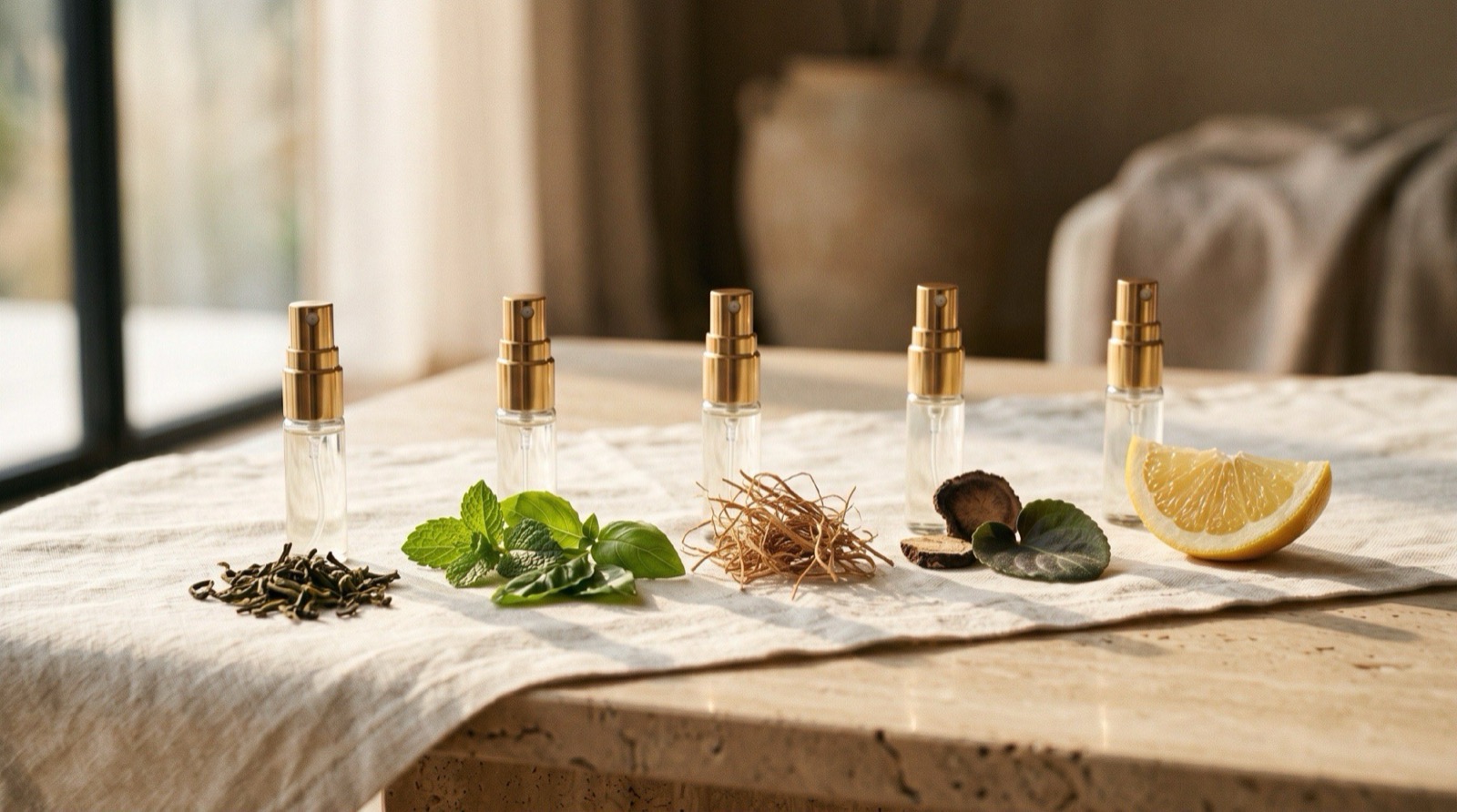
Six changes that cost nothing and fix most of the complaint:
- Spray less, and spray sooner. Two sprays on oily skin can carry further than four on dry skin. Start low and add next time.
- Move away from your warmest, oiliest sites. Sebaceous glands are especially dense on the face and scalp, so the neck and jaw are the amplifier. The chest under a shirt, the inner forearm, or the collar and lapel of a jacket are all gentler.
- Spray onto clothing for the sweet ones. Fabric produces no sebum and no heat, so a gourmand on a scarf behaves much closer to how it smells in the bottle. Check for staining on light fabrics first.
- Skip the moisturiser step. It is genuinely useful advice for dry skin and unnecessary for you — you already have the fixative.
- Mind concentration. Fragrance oil load is a real, industry-standard variable: eau de toilette runs “5-15%,” eau de parfum “around 15-20%,” and parfum “usually 20-30%” (Source: Ulta Beauty). If a fragrance you love is too much on you, the same scent in a lighter concentration is often the whole fix.
- Reapply less than you think. Nose-blindness, not fade, usually prompts the top-up. Ask before you re-spray.
If you want the deeper version of how much scent actually reaches other people, we covered it in projection vs. sillage vs. longevity, and the underlying biology — including why the bacteria on your skin matter as much as the oil — in Sweat Doesn’t Actually Smell.
Let your skin decide
The Lenochová finding is the practical one to end on: the fragrance that works is a property of the blend, not the bottle. No article, ours included, can run that test for you. We can only make running it easy.
Pick two contrasting fragrances from the list above — one bright and astringent, one dry and woody — and wear each for a full month. Base Note is one flat price, $20 a month, for a 5 ml atomizer of designer or niche fragrance, about 60 sprays, with no surcharge for the expensive houses. Swap monthly, cancel anytime, and your first month is 25% off. If you would rather be pointed somewhere than choose blind, the scent quiz takes about two minutes, or you can read the full 32-fragrance rotation and build from there. If you are still deciding what you are looking for at all, our five-step process for finding a signature scent is the place to start.
One flat price. Every luxury fragrance. Build your signature rotation.
— Jeff Theefs & Alex Cherne, Founder & Cofounder, Base Note