
Disclosure first: we run Base Note, a $20/month fragrance subscription that ships one 5 ml atomizer at a time, so a post about fragrance going off is not exactly against our interests. Worth saying plainly. But most of this applies to the $300 bottle already on your dresser, and the most valuable instruction here — move it out of the bathroom — costs nothing and sells nothing.
If you only read one thing: Fragrance does not have an expiry date so much as an exposure budget, and four things spend it: light, heat, oxygen, moisture. A bottle kept in a dark drawer at steady room temperature, in its box, holds for years. The same bottle on a sunlit bathroom shelf, cooked by a shower twice a day, can turn noticeably sour inside twelve months — and the citrus and aquatic openings turn first, while the heavy woods and vanillas barely flinch. Put the bottle in a drawer. That is the whole trick.
Nobody is required to tell you when it expires
Start with the regulatory floor, because it explains why the advice online is such a mess. In the US there is no rule at all: “There are no U.S. laws or regulations that require cosmetics to have specific shelf lives or have expiration dates on their labels.” The FDA defines shelf life as how long a product will “look and act as expected and to stay safe for use,” and says that length “varies, depending on the type of product, how it is used, and how it is stored.” (Source: FDA, Shelf Life and Expiration Dating of Cosmetics, emphasis ours.)
Europe is stricter, and its wording contains the most useful clause in this whole subject. Regulation 1223/2009 requires labelling of “the date until which the cosmetic product, stored under appropriate conditions, will continue to fulfil its initial function,” and exempts products lasting over 30 months, which instead carry the open-jar symbol and a number of months. (Source: Regulation (EC) No 1223/2009, Article 19(1)(c).) Even the strict regime only guarantees performance if you store it properly. The 36M on the box is not a countdown clock; it is a promise contingent on you holding up your end, and almost nobody does.
The four things that actually break a fragrance
A fragrance is a few dozen to a few hundred aroma molecules dissolved in ethanol and a little water — mostly terpenes, aldehydes, esters and aromatic compounds, most of them reactive. The encyclopedic summary is blunt and correct: “Fragrance compounds in perfumes will degrade or break down if improperly stored in the presence of heat, light, oxygen, and extraneous organic materials.” (Source: Wikipedia, Perfume — Preserving perfume.)
1. Light
Ultraviolet light carries enough energy to break chemical bonds, and the compounds that make a fragrance smell like anything are exactly the ones with bonds worth breaking. You do not need direct sun on a windowsill; ambient daylight across the room does it slowly, over months. Two symptoms follow: the liquid darkens, and the top of the scent flattens before the base does.
This is why luxury houses ship heavy tinted glass inside thick cardboard, which everyone assumes is theatre. Some of it is. Some of it is a UV filter you threw away. The conservation people are unambiguous: perfumes are best kept “in light-tight aluminium bottles or in their original packaging when not in use,” and the Osmothèque — the fragrance archive at 36 rue du Parc de Clagny, Versailles — keeps its historical formulas in non-actinic glass flasks flushed with argon, in thermally insulated compartments held at 12 °C. (Source: Wikipedia, Perfume — Preserving perfume.) You are not building an argon vault. You are being told, by people who take this seriously, that darkness and a stable cool temperature matter most.
2. Heat, and especially swings
Heat accelerates every reaction available to a fragrance: oxidation, hydrolysis of esters, rearrangement of terpenes. The FDA's advice is one line: “don't leave them where they are exposed to heat, such as in a hot car.” (Source: FDA.) A glove compartment in July is the fastest way to ruin a fragrance we know of.
The direction of the effect is documented outside perfumery too. A 2025 study stored myrtle essential oil at 25 °C, 4 °C and −20 °C and found that “lower storage temperatures, particularly −20 °C, tend to better preserve esters such as linalyl acetate over six months, while monoterpene hydrocarbons such as α-pinene and 1,8-cineole appear relatively stable even at 25 °C.” (Source: BMC Plant Biology, 2025.) That is a plant oil, not a finished perfume, and the authors call the underlying mechanisms speculative. But it shows the shape of the problem: cold preserves, warmth degrades, and different compound classes fail at different rates.
Swings are worse than a steady warm room. Every cycle expands and contracts the air in the bottle, pumping fresh oxygen past the liquid. A cupboard that runs 68 °F at night and 90 °F after a shower, twice a day every day, is doing something a steady 75 °F closet never does.
3. Oxygen, and the emptying bottle
Here is the mechanism almost nobody accounts for. The empty space above the liquid is the headspace, and it grows as you use the bottle. A full bottle holds almost no air; a bottle at the one-third mark is two-thirds air, in continuous contact with the juice. So the last third ages faster than the first third did, and it does so exactly when it has already been open the longest. This is why people say a fragrance they loved “went weird at the end” and blame a reformulation. Sometimes it is. Often it is arithmetic.
Two consequences. Atomizers beat splash bottles and roll-ons, because a spray pump never opens the reservoir to the room: sprays have “the advantage of isolating fragrance inside a bottle and preventing it from mixing with dust, skin, and detritus” (Source: Wikipedia, Perfume). And a small container you finish quickly never builds a large headspace.
4. Humidity
Water is the quiet one. Moisture drives hydrolysis, which turns esters — the fruity, floral, powdery half of most modern fragrances — back into their component acids and alcohols. The FDA names the room directly: “Exposure to moisture, such as in a bathroom, may make it easier for bacteria and fungi to grow.” (Source: FDA.) In fairness that lands on creams far harder than on a high-proof alcoholic perfume. Your cologne is not growing anything. It is still the wrong room.
Why the bathroom is the worst room in the house
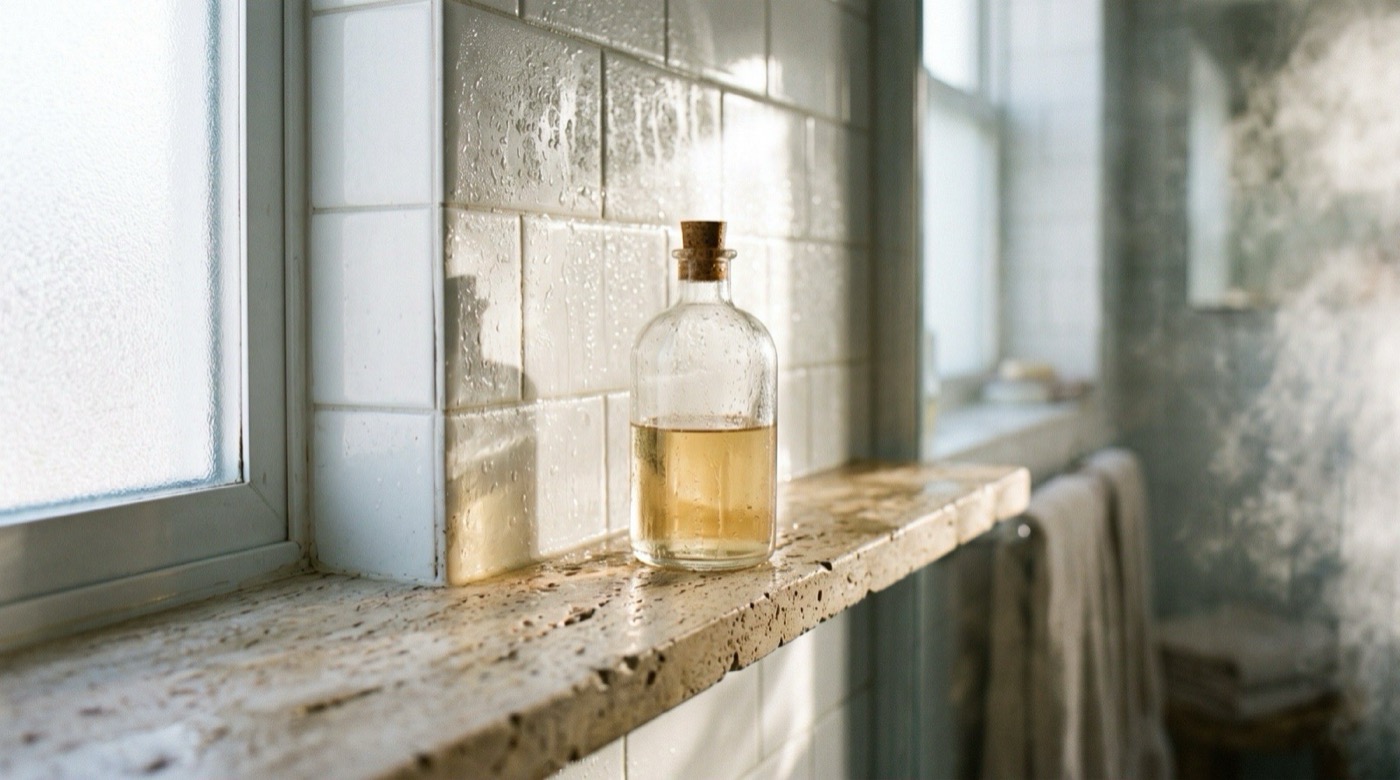
Now stack all four. A bathroom is the only room in a home that reliably delivers every one of them at once: a bright window or a bank of vanity bulbs, a temperature that spikes twice a day, humidity that goes to saturation and back, and a shelf where the bottles sit unboxed because they look good there. That is the difference between a bottle you still enjoy in 2032 and one gone sour by next autumn.
The best place is boring
The ideal location is one you would call dull: dark, dry, cool, stable. A closet shelf, a dresser drawer, a cabinet on an interior wall — interior matters more than people expect, because a closet on an exterior wall in a cold climate swings with the weather. Keep the outer box too. It is a free light-tight sleeve, and the objection that it hides your collection is real but losing: keep the boxes in a drawer and one bottle out on rotation.
Refrigeration works and is mildly overkill for most people. The archival recommendation is 3–7 °C (Source: Wikipedia, Perfume), which a wine fridge hits comfortably. Avoid the kitchen fridge, though: food odours, and a door that opens all day is a temperature-swing generator. A steady dark closet beats a busy fridge.
Realistic shelf life, by what is on top
Concentration is part of the answer — more aromatic material, less alcohol, a more robust liquid — which we covered in EDT vs EDP vs Parfum. But the better predictor is what the fragrance is made of. Volatile citrus and aquatic materials are fragile and sit at the top of the pyramid; resins, woods, ambers and vanillas are heavy, stable, and sit at the bottom (see fragrance notes explained). The table is our working rule of thumb from handling a lot of bottles, not laboratory data. Treat it as directional.
| Style | Example in the rotation | What degrades first | Well stored, opened | Badly stored (bathroom) |
|---|---|---|---|---|
| Citrus / aquatic fresh | Acqua di Gio Profondo, D&G Light Blue | The opening, within weeks of turning | 2–3 years | Under a year |
| Green, fresh | Creed Green Irish Tweed, Creed Silver Mountain Water | Brightness flattens, goes waxy | 2–4 years | 1–2 years |
| Fruity signature | Creed Aventus, Xerjoff Erba Pura | Pineapple and blackcurrant lose lift | 3–5 years | 1–2 years |
| Aromatic / spicy woody | YSL Y Intense, Bond No. 9 Nomad | Top citrus only; the woods hold | 4–6 years | 2–3 years |
| Amber, vanilla, gourmand | Parfums de Marly Layton, Spicebomb Extreme | Very little; may deepen | 5–10 years | 3–5 years |
| Oud, resin, leather | Bvlgari Le Gemme Orom, Parfums de Marly Haltane | Essentially the last to go | 10 years or more | 5 years or more |
The pattern is worth internalising: a fragrance does not die all at once, it dies from the top down. An aged citrus scent still has a perfectly good base. It has lost the first fifteen minutes, which is often the fifteen minutes you bought it for. A heavy amber like Xerjoff Alexandria II, meanwhile, does what a well-kept bottle of spirits does: changes slowly, and not always for the worse.
How to tell when one has turned
A sour or sharp opening. The classic: the first thirty seconds smell acidic, vaguely like nail polish or old wine, sometimes with an odd minty edge, before the fragrance settles into something recognisable. There is real chemistry under this. Limonene, the dominant molecule in citrus peel oils, “oxidizes easily in moist air to produce carveol, carvone, and limonene oxide” (Source: Wikipedia, Limonene), and the 1992 study behind that finding named (R)-(−)-carvone among the “5 main oxidation products” (Source: Karlberg, Magnusson & Nilsson, Contact Dermatitis, 1992) — the molecule behind “the sweetish minty smell of spearmint leaves” (Source: Wikipedia, Carvone). A minty-sour ghost over a lemon top note is not your imagination. It is the citrus becoming something else.
A metallic or flat edge. Harder to describe, easy to recognise: the scent reads thin and tinny, as if a layer were removed. Usually aldehyde and ester loss, and it hits clean, soapy, fresh compositions hardest.
Colour shift. The FDA's phrasing covers it: “Temperature changes and exposure to sunlight and air can cause changes in color and texture and may cause the products to smell.” A juice that has darkened two or three shades against a white sheet of paper has been through something. Caveat honestly: plenty of fragrances darken with age and smell fine, and some are dark from day one. Colour corroborates; it never convicts.
If the base is still good, a turned citrus scent is fine for the gym and not fine for a first impression. And if a fragrance ever irritates your skin, stop using it and talk to a doctor.
The 5 ml atomizer is a different object
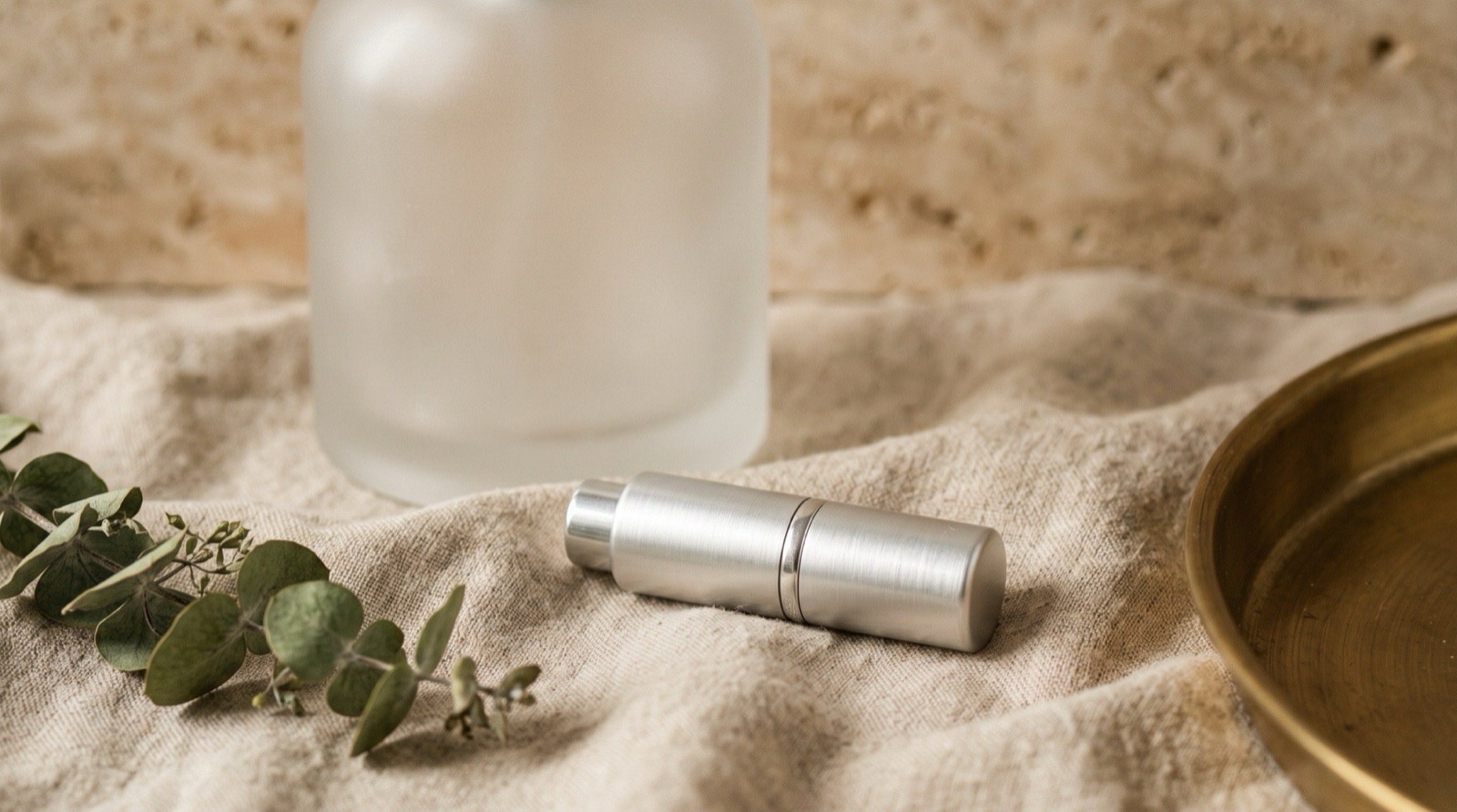
Everything above assumes a 50 or 100 ml bottle you will own for years. A 5 ml atomizer breaks most of those assumptions in your favour, and this is the part where we obviously have a horse in the race, so here is the honest version. The good news is structural: the housing is opaque aluminium, the exact material the archivists recommend; the headspace stays small in absolute terms, roughly 3 ml of air in a two-thirds-empty 5 ml vial against roughly 67 ml in a two-thirds-empty 100 ml bottle; and it is a spray, not a splash, so the liquid is never open to the room.
The better news is that it is meant to be used up. One of ours is about 60 sprays, roughly a month at two sprays a day — arithmetic we did properly in how long a 5 ml atomizer lasts. Degradation is exposure multiplied by time, and a container emptied inside a few months accumulates little of either.
The caveats, honestly. A decant has been transferred once, so it saw air during filling that a factory-sealed bottle never did. And small containers live in pockets, gym bags and hot cars, which undoes every advantage above — a 5 ml vial on a dashboard is worse off than a 100 ml bottle in a closet. Treat them as fresh produce, not as a cellar.
What we would actually do
Five things, in order of how much they matter.
- Move everything out of the bathroom today. A dresser drawer is enough, and this one change is worth more than the other four combined.
- Keep the boxes. Free UV protection, at the cost of a shelf.
- Never leave a bottle in a car. Not overnight, not for an afternoon errand in August.
- Finish the fragile ones first. If you own a citrus and a heavy amber, wear the citrus this season and let the amber wait. It genuinely can.
- Buy smaller, more often, while you are still exploring. A 100 ml bottle of something you wear four times a year spends a decade oxidising in slow motion. That tradeoff, at length: is a fragrance subscription worth it and should you sample before you buy.
What we cannot tell you
Nobody publishes per-fragrance stability data. Houses test, but “the law does not require cosmetics companies to share testing and tracking information with FDA” (Source: FDA), so anyone quoting a precise year count for a specific bottle, us included, is extrapolating. Better to know the mechanism than trust a number nobody can source.
Where Base Note fits, briefly
Our model is the small-container answer to this problem. One 5 ml aluminium atomizer a month, about 60 sprays, $20 flat — the same $20 for a Creed as for a designer house, because we do not surcharge the expensive ones. First month is 25% off, so $15. Swap your next fragrance from your account page or let us curate; cancel anytime. Subscription orders ship free within two business days, tracked, to US addresses. Single vials can also be bought one-time at the same $20, with $4.99 shipping under $50 and free at $50 and over.
No idea where to start? The two-minute quiz is the fastest route, or browse all 32 fragrances. Building a collection rather than hunting one bottle? The five-slot rotation is our framework, and the fall guide is the seasonal shortlist.
Or ignore all of it and go move your bottles into a drawer. That is still the highest-return ninety seconds in this article.
— Jeff Theefs & Alex Cherne, Founder & Cofounder, Base Note