
Disclosure first: we run Base Note, a $20/month fragrance subscription, and every scent named below is one we ship — so we plainly have a reason to want you wearing two things at once instead of one. Here is what we would tell a friend anyway, including the part where layering is mostly unnecessary and the part where our own bestsellers are on the do-not-combine list.
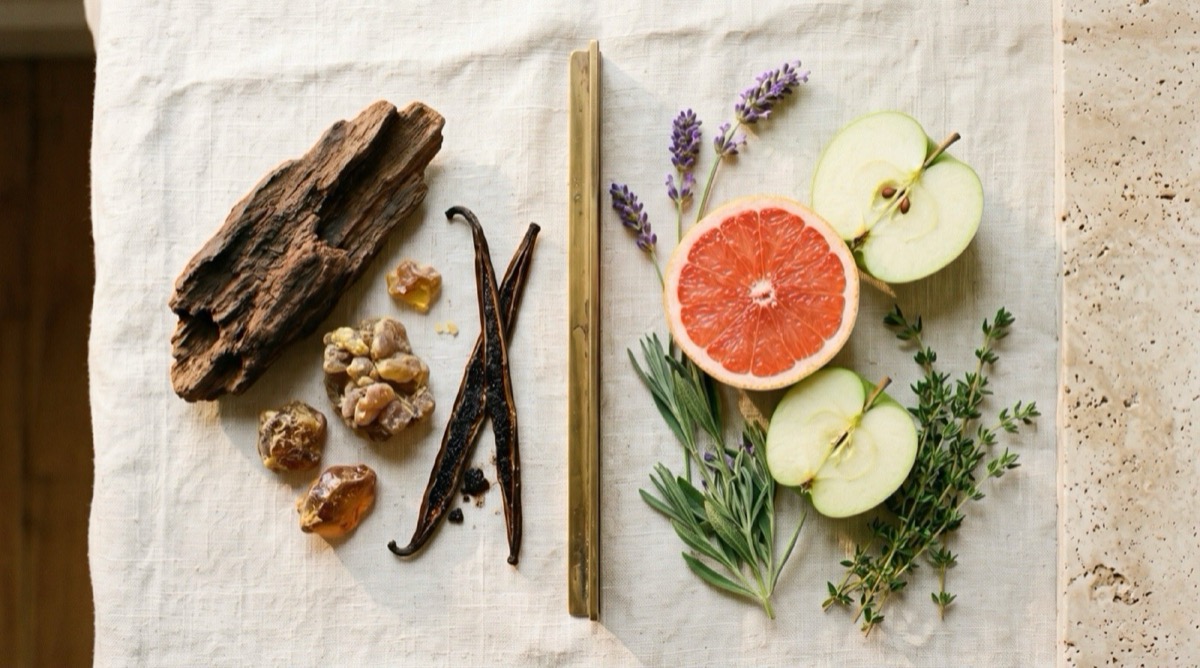
If you only read one thing: Layering is not mixing two scents you like. It is adding a bright top to a base you have already committed to. Pick one fragrance that is heavy at the bottom — vanilla, amber, oud, sandalwood, musk — and one that is bright at the top — citrus, apple, mint, green herbs. Spray the heavy one first, on skin, two or three sprays. Let it sit sixty seconds. Then one or two sprays of the bright one on a different spot. Total sprays should match what you would have used wearing either alone. If the two share at least one real note, they read as one fragrance instead of two. If they do not, you have made a smell, not a scent.
What layering actually is
Every fragrance is already a layered object — a pyramid: light molecules on top that you smell instantly, a heart underneath, heavy molecules at the bottom that stay. The encyclopedic description is precise about the physics: top notes “consist of small, light molecules that evaporate quickly,” while base notes are made of “large, heavy molecules that evaporate slowly” and can “still be detectable in excess of twenty-four hours” (Source: Wikipedia, “Note (perfumery)”). Heart notes sit between them and, per the same entry, “disappear anywhere from twenty minutes to one hour after the application.”
So when you layer you are not blending two equal things. You are stacking two pyramids and hoping the tops of one land on the base of the other without a collision in the middle. The long version is in fragrance notes explained.
The second piece of physics that matters is fixation. A fixative is “a substance used to equalize the vapor pressures, and thus the volatilities, of the raw materials in a perfume oil, and to increase the perfume’s odour tenacity,” working by “slowing the rate at which the lighter scent molecules evaporate into the air” (Source: Wikipedia, “Fixative (perfumery)”). The same entry lists resinoids such as benzoin and tolu balsam, and polycyclic ketones such as civetone and muscone. That is the mechanism behind the whole exercise: a resin-and-musk-rich base does not just sit under a citrus opening, it holds that opening in place longer than it would have lasted alone.
Complementary versus clashing: the bridge note
The test is simple. Read both note lists. Find one note in both, or a pair from the same family in adjacent positions — bergamot and grapefruit, lavender and clary sage, vanilla and benzoin. That is the bridge, and it is what makes a nose hear one fragrance instead of two.
Without a bridge you get two unrelated signals at once, and three or four loud unrelated accords stop smelling like anything specific and start smelling generically strong. That is what people call “muddy.”
The base-heavy plus bright-top rule
Assign roles before you spray. One fragrance is the foundation: a base of vanilla, amber, oud, benzoin, tonka, sandalwood, patchouli or musk, and what you will still be wearing at 6 p.m. The other is the lift: citrus, green apple, mint, herbs, sea notes — something that lives in the first ninety minutes and then politely leaves.
Two foundations is the most common mistake. Two lifts is the second, and quieter: slightly louder than either alone, no added dimension, two vials spent to arrive where one would have taken you.
Order of application, and why it is not arbitrary
- Foundation first, on bare skin. Skin warmth does real work — the pulse-point tradition exists because “the pulse point will warm the perfume and release fragrance continuously” (Source: Wikipedia, “Perfume”). Chest and lower neck, two or three sprays.
- Wait sixty seconds. Not for chemistry, for alcohol. Spraying into a still-wet patch dilutes both.
- Lift second, on a different spot. One or two sprays on the neck or wrists. Adjacent, not stacked — a few inches of separation lets the two meet in the air at the ratio your movement decides.
- Do not rub. Rubbing crushes the top notes of the lift, which is the only reason you added it.
- Stop. Wait twenty minutes before deciding. Layered pairs almost always smell wrong at minute three, because you are hearing two sets of top notes and none of the settling.
How many sprays
The budget is the total, not the per-bottle count. If you normally wear four sprays, layering means three plus one, or two plus two — never four plus four. Doubling your dose is how a thoughtful pairing becomes the thing your colleagues discuss without you. Dosage in full: how many sprays of cologne you should actually use, plus projection vs sillage vs longevity.
Ratio is the dial. Start at 3:1 in favour of the foundation. Flat, go 2:2. Chaotic, reverse it or drop the pair. Your own nose stops judging reliably after a few minutes — olfactory fatigue is “the temporary, normal inability to distinguish a particular odor after a prolonged exposure to that airborne compound” (Source: Wikipedia, “Olfactory fatigue”). Ask one person you trust, once.
Six pairings from our rotation that actually bridge
Every fragrance below is in the Base Note rotation at $20 for a 5 ml atomizer, about 60 sprays. The bridge column is the honest reason each pair works.
| Foundation (spray first) | Lift (spray second) | The bridge | Spray plan | Best for |
|---|---|---|---|---|
| Parfums de Marly Layton | Parfums de Marly Perseus | Bergamot in both tops; geranium echoes in both hearts | 2 + 1 | Fall office, when Layton alone is too loud |
| Creed Santal | Creed Silver Mountain Water | Sandalwood (Santal’s heart, SMW’s base); bergamot in both | 3 + 1 | Cool spring mornings, long days |
| Bvlgari Le Gemme Orom | Xerjoff Erba Pura | Vanilla, plus benzoin meeting amber | 2 + 2 | Evening, cold weather, being noticed |
| Dolce & Gabbana The One | Dolce & Gabbana Light Blue | Grapefruit in both tops; cardamom and pepper in the middle | 3 + 1 | Shoulder season, day to evening |
| Givenchy Gentleman | YSL Y Intense | Lavender and patchouli | 2 + 2 | Winter, formal, indoors |
| Emporio Armani Stronger With You Intensely | Xerjoff Torino 21 | Lavender, and sage meeting rosemary and thyme | 2 + 2 | Adventurous; test at home |
Layton and Perseus
The cleanest pairing we know, and the one to start with. Layton opens on apple, bergamot and cardamom and lands on vanilla, patchouli, guaiacwood and praline. Perseus opens on bergamot and grapefruit, hearts on geranium and blackcurrant bud, and lands on vetiver, amberwood and grey amber. Bergamot sits in both openings, and geranium threads through both hearts — a wide bridge. The result is Layton with the sweetness turned down and the opening stretched by an hour. If our Layton review left you thinking it was slightly too loud for your life, this is the fix.
Creed Santal and Silver Mountain Water
Santal opens on juniper, ginger and cinnamon, hearts on sandalwood, lavender and orange blossom, and lands on tonka, vanilla and benzoin. Silver Mountain Water is bergamot and mandarin over green tea and blackcurrant — and, importantly, sandalwood in the base. The shared sandalwood stops this reading as two Creeds fighting; the green tea sits over the spice like a cold window in a warm room. Three sprays of Santal, one of Silver Mountain Water. If you are choosing between the two Creed freshies, we compared them in Green Irish Tweed vs Silver Mountain Water.
Le Gemme Orom and Erba Pura
The most dramatic pair here. Orom is three ingredients doing one thing — bourbon vanilla, Siam benzoin, oud — an ideal foundation, because there is nothing in it to argue with. Erba Pura is Sicilian orange, bergamot and lemon over white musk, vanilla and amber. Vanilla is shared outright, and Orom’s benzoin meets Erba Pura’s amber as one resinous floor. Candied citrus over oud, genuinely different from either bottle. Also very loud. Not for the office.
The One and Light Blue
Two staples most people own separately and never think to combine. Both open on grapefruit, and that shared top carries the handoff from The One’s cardamom-and-tobacco warmth to Light Blue’s pepper, rosemary and juniper — which keeps the tobacco from getting heavy in daylight.
Gentleman and Y Intense
Gentleman is a short, dark list — pepper and lavender, then iris and tolu balm, then patchouli and black vanilla. Y Intense is ginger, bergamot and juniper over sage, geranium and lavender, landing on vetiver, patchouli and cedar. Lavender and patchouli appear in both, in different positions, which is the interlock you want, and the vetiver cuts the powder of the iris. Our pick for a winter event, indoors, close to people.
Stronger With You Intensely and Torino 21
The experiment. Stronger With You Intensely is toffee, cinnamon, lavender and sage in the heart, landing on vanilla, tonka and amber; Torino 21 is mint, lemon, basil and thyme over lavender and rosemary. Lavender is the literal bridge, the herbs the conceptual one — herbal-over-gourmand is a real and under-used shape. It also fails for about half the people who try it, because a mint opening over toffee reads as toothpaste to some noses. Test this at home on a Saturday, not before a dinner.
What almost never works
Two loud orientals. Xerjoff Alexandria II and Parfums de Marly Haltane both carry oud in the base, and both are spiced, cinnamon in one, saffron in the other. On paper, a real bridge. In practice they overlap so completely that you get no contrast, no lift and double the dose of the loudest thing you own. Same story for Initio Side Effect with Spicebomb Extreme — rum, cinnamon and tobacco meeting cinnamon, cumin and tobacco. A bridge is necessary, not sufficient. You also need something to bridge to.
Two aquatics or two fresh citruses. Acqua di Gio Profondo over Light Blue is the classic version. Sea notes, bergamot and mandarin over grapefruit, bergamot and juniper, both landing on musk. Not unpleasant. Just louder Light Blue, and you used two vials to get there.
Two headliners. Creed Aventus and Layton are both designed to be the only thing in the room. Aventus’s birch and pineapple against Layton’s apple-vanilla makes a fruit accord nobody asked for. If a fragrance is the reason people remember your name, it needs no partner.
Two near-identical gourmands. Parfums de Marly Althair and Pegasus share bergamot and vanilla. Layering them changes nothing except how fast you finish both.
Skin or fabric
Skin is where layering happens, because skin is where the variables are. Dry skin is a real constraint: “dry skin will not hold fragrance as long as skin with more oil” (Source: Wikipedia, “Perfume”). On the dry end, moisturise with something unscented first and lean harder on the foundation. On the oily end, we went through which notes behave in best fragrance notes for oily skin, and why the same bottle reads differently on different people is covered in why perfume smells different on me.
Fabric is a different instrument, used sparingly. Cloth holds scent longer than skin and gives none of the warmth-driven evolution, so a fragrance on a collar stays roughly as it landed. That makes it a reasonable home for the foundation — one spray inside a jacket, never the outside — and a poor home for the lift, whose job is to open and get out of the way. Two cautions: resinous base notes such as oud, patchouli and vanilla can mark pale or delicate fabric, so keep them off silk and linen; and you cannot wash a mistake off a shirt at 9 a.m. the way you rinse a wrist.
How to test a pairing without buying two bottles
This is the part where our interest is obvious, so take it with the appropriate salt. Most people never learn to layer because the experiment normally costs two full-price bottles of things you might discover do not go together. A 5 ml atomizer holds roughly 60 sprays — at the plans above, 20 to 30 wearings of a pairing. Enough to know.
Base Note is $20 a month for one 5 ml atomizer, first month 25% off at $15, and you swap what comes next from your account page or let us curate. To test a pairing rather than a single scent, add a second vial — and single vials can be bought one-time at $20 without subscribing, which is the honest right answer if all you want is one experiment. Shipping is $4.99 under $50 and free at $50 and over; subscription orders always ship free. Everything ships within two business days, tracked, to US addresses.
Two practical notes. Run a pairing on three separate days before judging it — weather and what you ate both move the result, an effect covered in foods that make you smell. And write down the ratio. You will not remember whether it was 3:1 or 2:2, and that difference is most of the outcome.
The honest limits
Most people should not layer. One well-chosen fragrance, dosed correctly, beats a clever pairing dosed carelessly nearly every time. It is a fourth or fifth move — if you are still assembling the basics, the five-slot rotation and how to find your signature scent are the more useful projects.
We also cannot tell you what a pairing will smell like on you. Nobody can. Diet, medication and skin chemistry all shift the result — “eating spicy and fatty foods can increase the intensity of a fragrance,” and “the use of medications can also impact the character of a fragrance” (Source: Wikipedia, “Perfume”). And if fragrance of any kind gives you headaches, breathing trouble or a skin reaction, that is a conversation for a doctor, not a blog post — doubling up is the wrong direction entirely.
If you would rather skip the theory: take our two-minute quiz, or browse all 32 fragrances and pick a foundation and a lift with a shared note. That is the whole method.
— Jeff Theefs & Alex Cherne, Founder & Cofounder, Base Note